
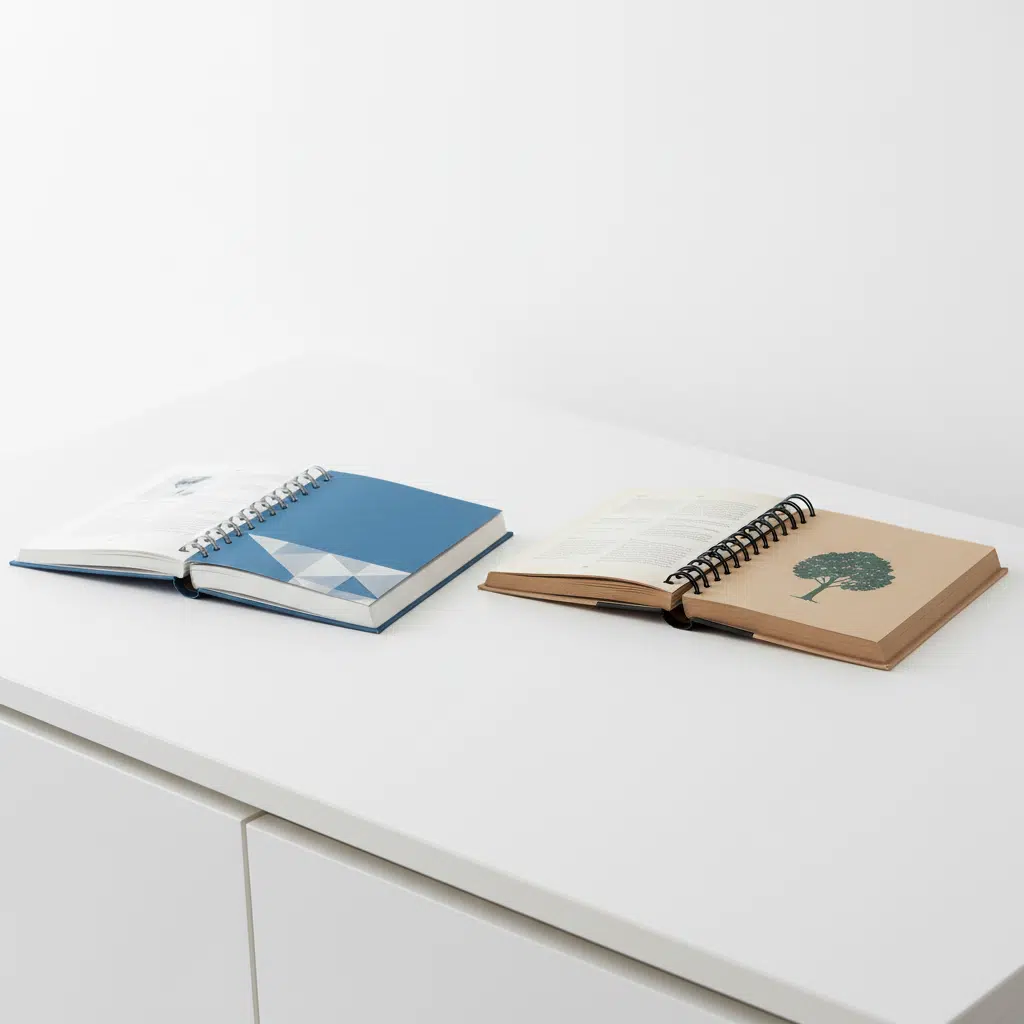
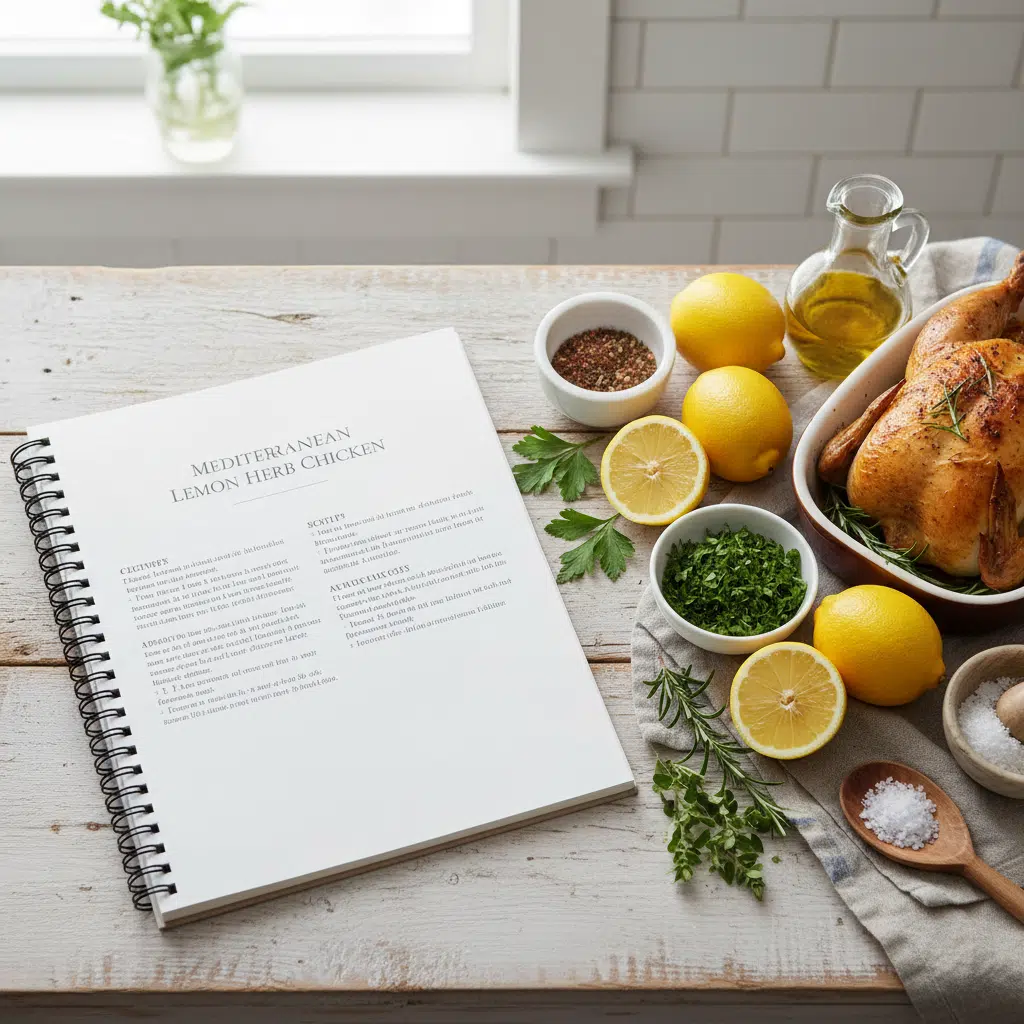
Pour les publications fonctionnelles telles que les manuels techniques, les livres de cuisine, les cahiers d'exercices et les plans d'entreprise, la méthode de reliure n'est pas seulement un choix esthétique, c'est une nécessité fonctionnelle. Ces documents sont des outils ; ils doivent rester ouverts les mains libres, résister à des manipulations fréquentes et permettre une navigation aisée.
Les deux solutions de reliure mécanique les plus populaires pour les projets d'impression B2B sont les suivantes Liaison Wire-O (également connu sous le nom de fil Twin-Loop ou Double-Loop) et Reliure spirale (bobine de plastique). Bien qu'ils aient en commun la capacité de s'ouvrir à 360 degrés et de se poser complètement à plat, leur durabilité, leurs profils de coûts et leurs présentations visuelles diffèrent considérablement.
Ce guide compare la reliure Wire-O et la reliure spirale afin d'aider les responsables des achats et les acheteurs d'imprimés à choisir la bonne spécification pour leur projet.
Définir les concurrents : Wire-O vs. Spiral
Qu'est-ce que la reliure Wire-O ?
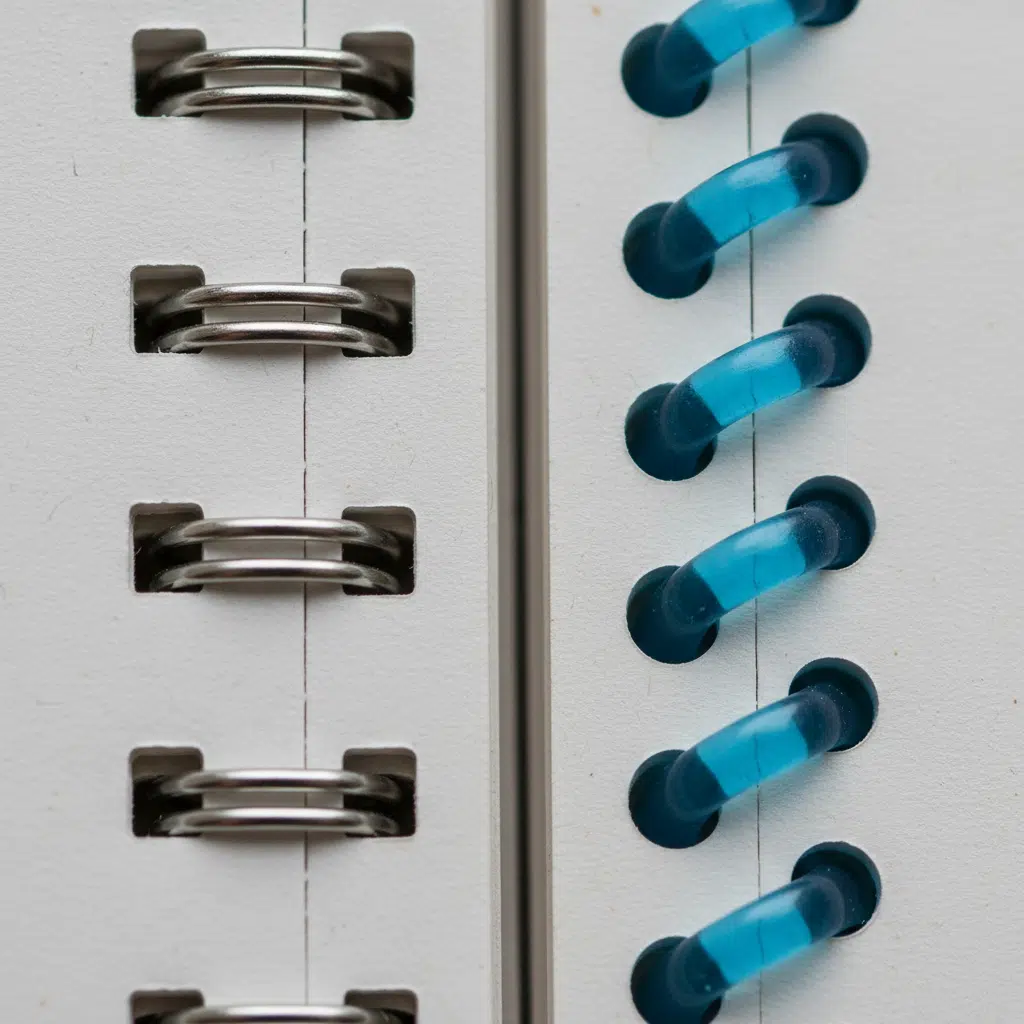
La reliure Wire-O utilise un fil métallique préformé en forme de "C". Le fil est inséré dans des trous carrés ou ronds perforés le long du bord du corps d'ouvrage, puis pressé mécaniquement pour former une double boucle ronde. Elle est largement considérée comme la norme professionnelle pour les rapports d'entreprise, les calendriers haut de gamme et les documents de présentation.
Qu'est-ce que la reliure spirale ?
La reliure spirale utilise un filament continu de plastique (PVC) formé en hélice (bobine). Cette bobine est filée à travers une série de trous ronds très rapprochés le long du bord de la reliure. Les extrémités de la bobine sont serties pour l'empêcher de s'enrouler. En raison de son élasticité, il est couramment utilisé pour le matériel éducatif, les menus de restaurant et les manuels industriels.
Comparaison en bref
| Fonctionnalité | Reliure Wire-O | Reliure spirale |
|---|---|---|
| Matière première | Fil métallique enrobé | Plastique PVC flexible |
| Durabilité | Modéré (le fil peut se plier ou s'écraser) | Haut (rebondit, résiste à l'écrasement) |
| Esthétique | Professionnel, élégant, corporatif | Fonctionnel, décontracté, coloré |
| Alignement des pages | Enregistrement parfait (bon pour les crossovers) | Léger décalage sur les pages ouvertes |
| Nombre maximal de pages | Généralement jusqu'à 1,25″ d'épaisseur | Peut accueillir des livres plus épais (jusqu'à 2″+) |
| Coût | Prime légèrement plus élevée | Généralement plus économique |
Plongée en profondeur : Durabilité et longévité
Lorsque vous choisissez une méthode de reliure, tenez compte de l'environnement dans lequel le livre sera utilisé.
La reliure spirale : Le cheval de bataille de l'industrie
La reliure spirale en plastique est pratiquement indestructible dans des conditions normales d'utilisation. Si un manuel à reliure spirale tombe, si on marche dessus ou si on le pousse dans un carton d'expédition étroit, la spirale en plastique fléchit et reprend sa forme initiale. C'est donc le meilleur choix pour :
- Manuels de sécurité industrielle utilisés dans les usines.
- Cahiers d'exercices scolaires manipulés quotidiennement par les élèves.
- Menus des restaurants qui doivent constamment s'ouvrir et se fermer.
Wire-O : à manipuler avec précaution
Bien que le Wire-O soit robuste, les boucles métalliques peuvent être écrasées si une forte pression est exercée directement sur le dos. Une fois que le fil est déformé, les pages peuvent devenir difficiles à tourner. C'est pourquoi le Wire-O convient mieux aux environnements de bureau, aux salles de conférence ou aux produits vendus dans un emballage protecteur (comme les pochettes ou les films rétractables).
Considérations relatives à l'esthétique et à l'image de marque
Wire-O est généralement préféré pour les projets où la perception de la marque est primordiale. L'aspect double fil est plus net et plus sophistiqué. C'est la norme pour les rapports annuels, les propositions architecturales et les planificateurs haut de gamme. Les couleurs sont généralement limitées au noir, au blanc, à l'argent ou à l'étain, ce qui permet de conserver un aspect neutre et professionnel.
Reliure spirale offre une plus grande polyvalence dans la correspondance des couleurs, mais a un aspect plus utilitaire. La bobine continue peut être fabriquée dans des dizaines de couleurs PMS pour correspondre au logo d'une entreprise ou à la couverture d'un livre. Cependant, la finition plastique peut parfois être perçue comme moins "premium" que le métal.
Fonctionnalité : Croisements et enregistrement
Un détail technique souvent négligé est alignement croisé-Les images ou le texte qui s'étendent sur deux pages en regard (la marge).
- Wire-O : Maintient les pages parfaitement alignées horizontalement. Si une carte ou un diagramme s'étend sur les pages de gauche et de droite, Wire-O veille à ce que les lignes se rejoignent avec précision.
- Spirale : Comme la bobine se déplace en hélice, la page de gauche est toujours légèrement plus haute ou plus basse que la page de droite lorsque le livre est ouvert. Cela crée un effet de "marche". Les concepteurs doivent éviter les croisements critiques dans les documents reliés en spirale afin d'éviter tout désalignement.
Spécifications techniques pour les acheteurs
Lors d'une demande de devis pour une reliure mécanique, la spécificité permet d'éviter les retards.
Schémas de pas et de trous
Le "pas" désigne le nombre de trous par pouce.
- Wire-O Pitch : Généralement 3:1 (3 trous par pouce) pour les livres plus minces et 2:1 (2 trous par pouce) pour les livres d'une épaisseur supérieure à 5/8 de pouce. L'utilisation d'un pas inadapté à l'épaisseur du livre peut entraîner des difficultés à tourner les pages.
- Spiral Pitch : La norme est généralement 4:1 (4 trous par pouce). L'espacement plus serré des trous confère au papier une excellente résistance à la déchirure.
Options de couverture
Les deux styles de reliure permettent différentes configurations de couvertures :
- Couverture souple : Couvertures en carton standard (C1S ou C2S).
- Couverture rigide (exposée) : Une couverture en carton rigide où la reliure passe à travers le carton lui-même.
- Semi-caché : La reliure est visible à l'intérieur de la quatrième de couverture mais cachée sur le dos, ce qui permet d'avoir un dos imprimable pour une meilleure visibilité en rayon (plus courant avec Wire-O).
Fabrication et contrôle de la qualité
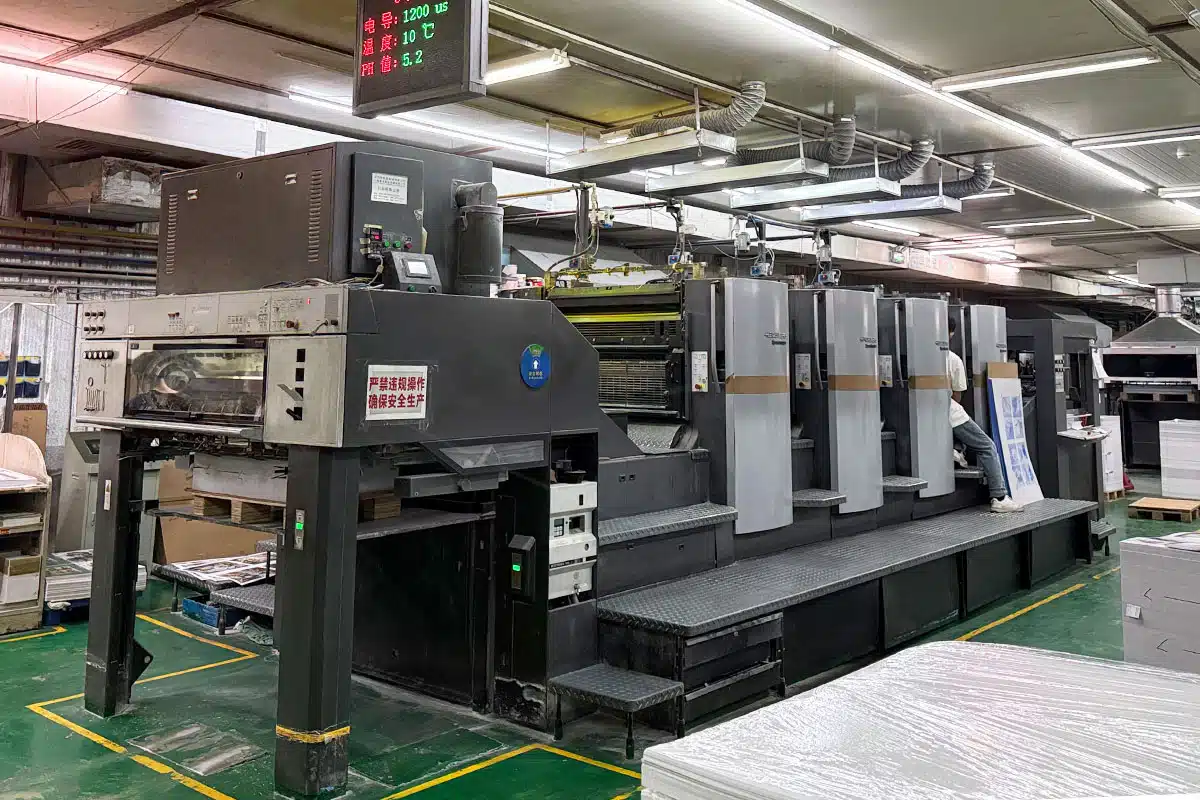
Chez YBJ Printing, nous mettons l'accent sur un contrôle de qualité strict pour la reliure mécanique afin d'éviter les défauts courants.
- Fermeture en fil de fer : Pour le Wire-O, le fil "C" doit être fermé en un cercle parfait. S'il n'est pas assez fermé, les pages tombent ; s'il est trop fermé, les pages ne tournent pas. Nous utilisons des lignes de reliure automatisées pour garantir une pression de fermeture constante.
- Sertissage de la bobine : Pour la reliure spirale, les extrémités doivent être coupées et serties à un angle précis. Un mauvais sertissage laisse des queues de plastique pointues qui peuvent égratigner les utilisateurs ou s'accrocher aux vêtements.
Guide d'achat : Délais de livraison et MOQ
Lorsque vous planifiez votre commande, tenez compte des éléments suivants :
- MOQ (Minimum Order Quantity) : Alors que l'impression numérique permet des volumes plus faibles, les installations de reliure industrielle sont plus rentables à partir d'un volume de 500 unités.
- Couleurs : Le fil ou la bobine standard noir/blanc est toujours en stock. Les couleurs PMS personnalisées pour les bobines en plastique peuvent nécessiter des délais plus longs et des minimums plus élevés.
- Expédition : Les livres en fil métallique doivent souvent être intercalés ou emballés avec soin pour éviter que les boucles de fil métallique ne rayent les livres adjacents ou ne s'imbriquent les unes dans les autres pendant le transport.
Questions fréquemment posées
Quelle est la reliure la moins chère ?
La reliure spirale est généralement moins chère que la reliure Wire-O en raison des coûts inférieurs des matériaux et des vitesses de production plus élevées, bien que la différence se réduise pour les petits tirages.
Puis-je imprimer sur le dos ?
Ni la reliure Wire-O standard ni la reliure spirale ne permettent d'imprimer le dos. Si le texte du dos est nécessaire pour la présentation en rayon, demandez une reliure Wire-O "semi-cachée" ou envisagez plutôt une reliure parfaite.
Quelle est l'épaisseur maximale ?
Les spirales peuvent relier des livres d'une épaisseur de 50 mm ou plus. Le Wire-O est généralement limité à environ 32 mm (1,25 pouce) ; au-delà, le fil devient instable et a tendance à s'ouvrir.
Ces fixations sont-elles écologiques ?
Le Wire-O métallique est souvent recouvert de nylon, mais le noyau est en acier, qui peut être recyclé s'il est séparé. Les bobines de plastique sont généralement en PVC. Pour les exigences écologiques strictes, renseignez-vous sur les options de filament PET ou les alternatives biodégradables.
Que vous ayez besoin de la durabilité d'une spirale pour un livre de cuisine très fréquenté ou de la précision élégante du Wire-O pour un manuel de formation d'entreprise, le choix de la bonne reliure garantit le succès de votre produit sur le terrain.
Prêt à démarrer votre projet ? Contactez notre équipe dès aujourd'hui pour discuter de vos spécifications et recevoir un devis personnalisé.