
جدول المحتويات
- What Is Bilingual Book Printing?
- 1. Define the Edition and Reader
- 2. Choose Where Each Language Appears
- 3. Reserve Space for Translation Expansion
- 4. Select Fonts That Support Both Languages
- 5. Set Reading Direction and Navigation
- 6. Coordinate Illustrations, Trim and Binding
- 7. Approve Language and Production Proofs
- Book Formats and Their Layout Implications
- قائمة مراجعة للمشتري قبل طلب عرض الأسعار
- Bilingual Book Printing FAQ
- Key Takeaways
Plan a readable dual-language picture book with seven practical decisions covering edition structure, language placement, text expansion, fonts, reading order, illustrations and proof approval.
What Is Bilingual Book Printing?
Bilingual book printing produces a physical book containing two written languages. For picture books and early readers, the central layout decision is how readers will move between those languages while following the same story and illustrations.
A practical bilingual page layout gives each language enough space, makes its reading order clear and keeps text legible at the finished size. Adding a translation to an already complete monolingual design can crowd the page, disrupt illustration placement and increase the page count.
The seven decisions below help publishers, authors and educational buyers prepare dual-language picture books before requesting production pricing. They also clarify which choices belong to editorial planning and which need confirmation with the printer.
Planning assumptions: This guide covers conventional printed picture books and early readers. Final cost and lead time depend on trim size, page count, quantity, paper, binding, finishing, proof requirements, file readiness and delivery destination. Translation length and script requirements must be assessed for the actual language pair.
1. Define the Edition and Reader
Decide whether both languages must appear together before setting the page grid. A shared bilingual edition supports side-by-side reading, while separate language editions give each text more room and allow different market-facing covers.
Start with the reading activity. Will an adult read aloud and switch languages? Will a child compare individual words? Will a teacher use the book for repeated reading? Sentence-level pairing may help comparison, but uninterrupted language blocks can make storytelling smoother.
Language edition planning should also identify the intended age group, whether either language needs pronunciation support, and whether both languages receive equal visual emphasis. Additional transliteration creates another text layer and needs its own space.
Record the language pair, reader age, reading activity, edition quantities and cover requirements in one specification sheet. If you are comparing separate editions with one shared edition, review the inventory implications in our guide to offset printing and print-on-demand fulfillment. Do not assume that dividing a total quantity between editions preserves the same unit price.
2. Choose Where Each Language Appears
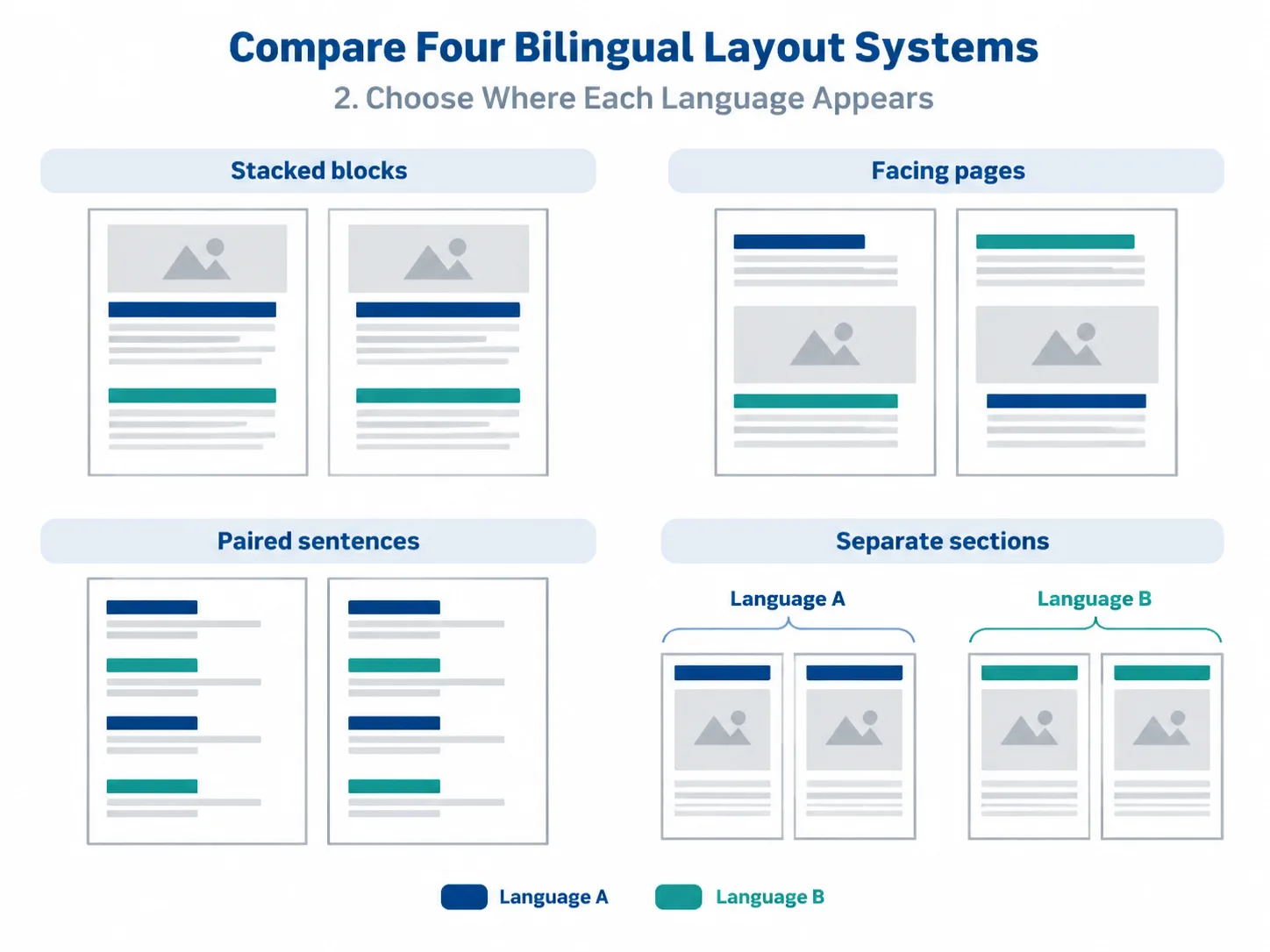
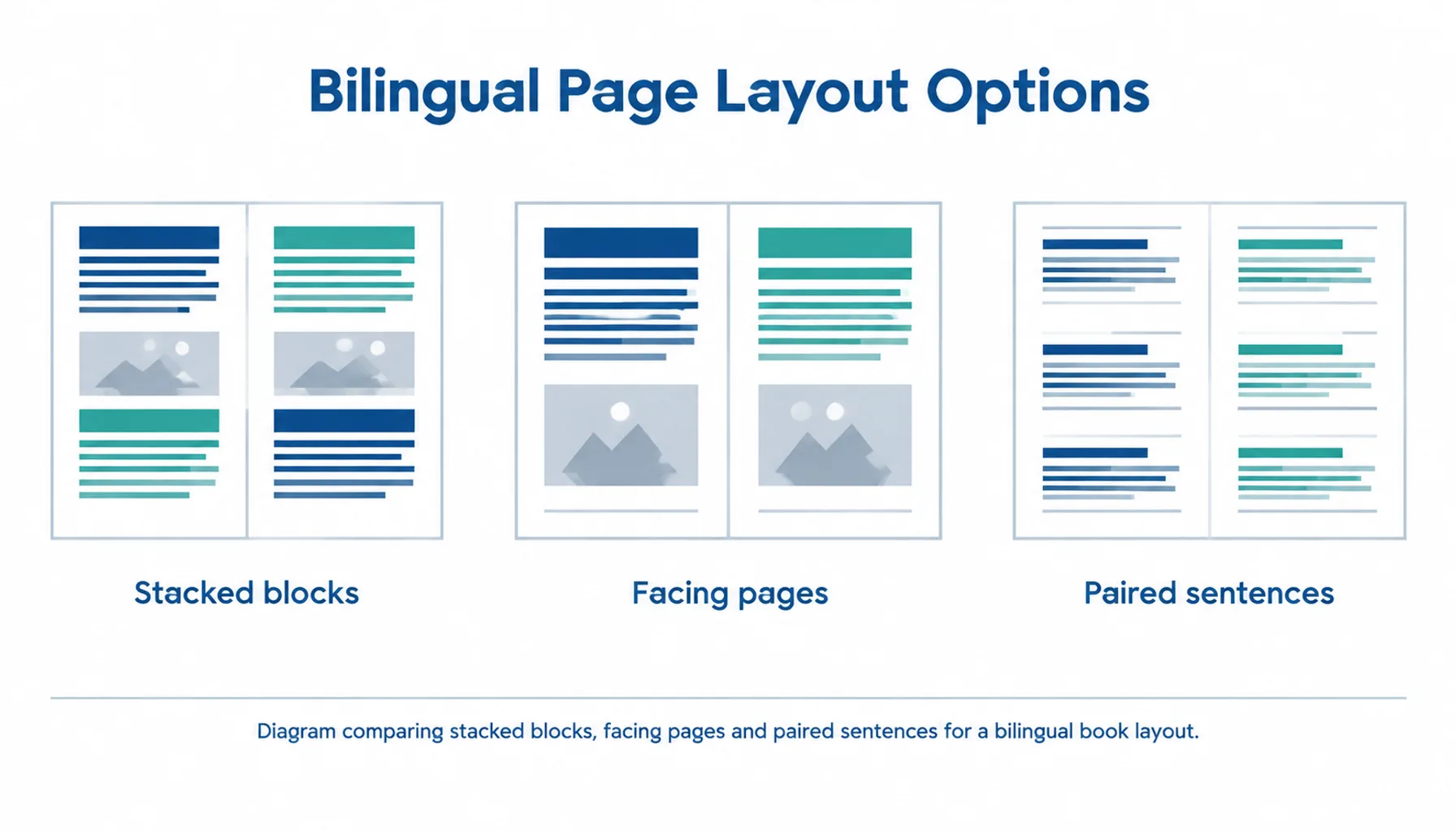
Choose one consistent placement system that matches how readers will use the book. Stacked text blocks, facing pages and paired sentences each create a different relationship between the languages.
| Layout option | Useful for | Main tradeoff | Check before approval |
|---|---|---|---|
| Stacked language blocks | Shared illustrations and adult read-aloud use | Both texts compete for vertical space | The longer block fits without crowding the artwork |
| Facing-page languages | Giving each language a clear reading area | Text placement can constrain spread compositions | The paired passages remain easy to identify |
| Paired sentences or lines | Short early-reader passages and direct comparison | Frequent switching can interrupt story flow | Each translation stays visibly paired with its source |
| Separate language sections | Reading the complete story in one language at a time | Repeating the story can increase page count | Section starts and navigation are clear |
Use stable position, spacing and language labels to distinguish the texts. Color can reinforce that system, but should not be the only identifier. Similar colors, low contrast or grayscale reproduction can make the distinction disappear.
Test the selected system on a quiet spread, a text-heavy spread and a spread with a major illustration. A layout that works only on the easiest page is unlikely to remain consistent throughout the book.
3. Reserve Space for Translation Expansion
Size text areas using the approved translation, not a fixed expansion percentage. Translated passages can become longer or shorter, and different scripts change line breaks, character density and vertical spacing.
Place both languages in the proposed fonts at the intended trim size. Include the longest passages, dialogue, repeated phrases and any vocabulary labels. Review punctuation and line-breaking conventions with a qualified reader of each language.
If text overflows, first revise the grid, adjust the illustration boundary or reconsider the passage division with the editor. Shrinking one language on difficult pages creates an uneven reading experience. Avoid compressing characters or reducing spacing merely to make a block fit.
Confirm the revised pagination with the printer before locking the cover. Additional pages can affect paper use, binding suitability and spine dimensions. For folded and gathered book construction, the permitted page-count increments depend on the production plan; agree them rather than assuming any count is workable.
4. Select Fonts That Support Both Languages
Choose fonts with the required characters, shaping support and embedding permissions. Visual similarity alone does not establish that a font can correctly render a language.
Children’s book typography needs assessment at actual print size. Equal point sizes can produce different apparent sizes across scripts, so compare the printed letterforms, line spacing and overall density. Keep accents and vowel marks clear of adjacent lines.
For scripts that require contextual shaping, use suitable layout software and have a fluent reviewer inspect the result. A file may contain every character while still displaying incorrect connections, positioning or punctuation.
Multilingual font embedding helps preserve the approved appearance in the production PDF. Check the exported file for missing glyphs, substitutions and embedded or properly subset fonts. Confirm that the font license permits the required embedding.
Follow a documented تصدير ملفات PDF الجاهزة للطباعة وسير عمل الفحص المسبق. If outlining text is necessary, agree it with prepress, retain an editable master and recheck the output. Outlining changes how text can be searched or edited and does not repair an incorrect layout.
5. Set Reading Direction and Navigation
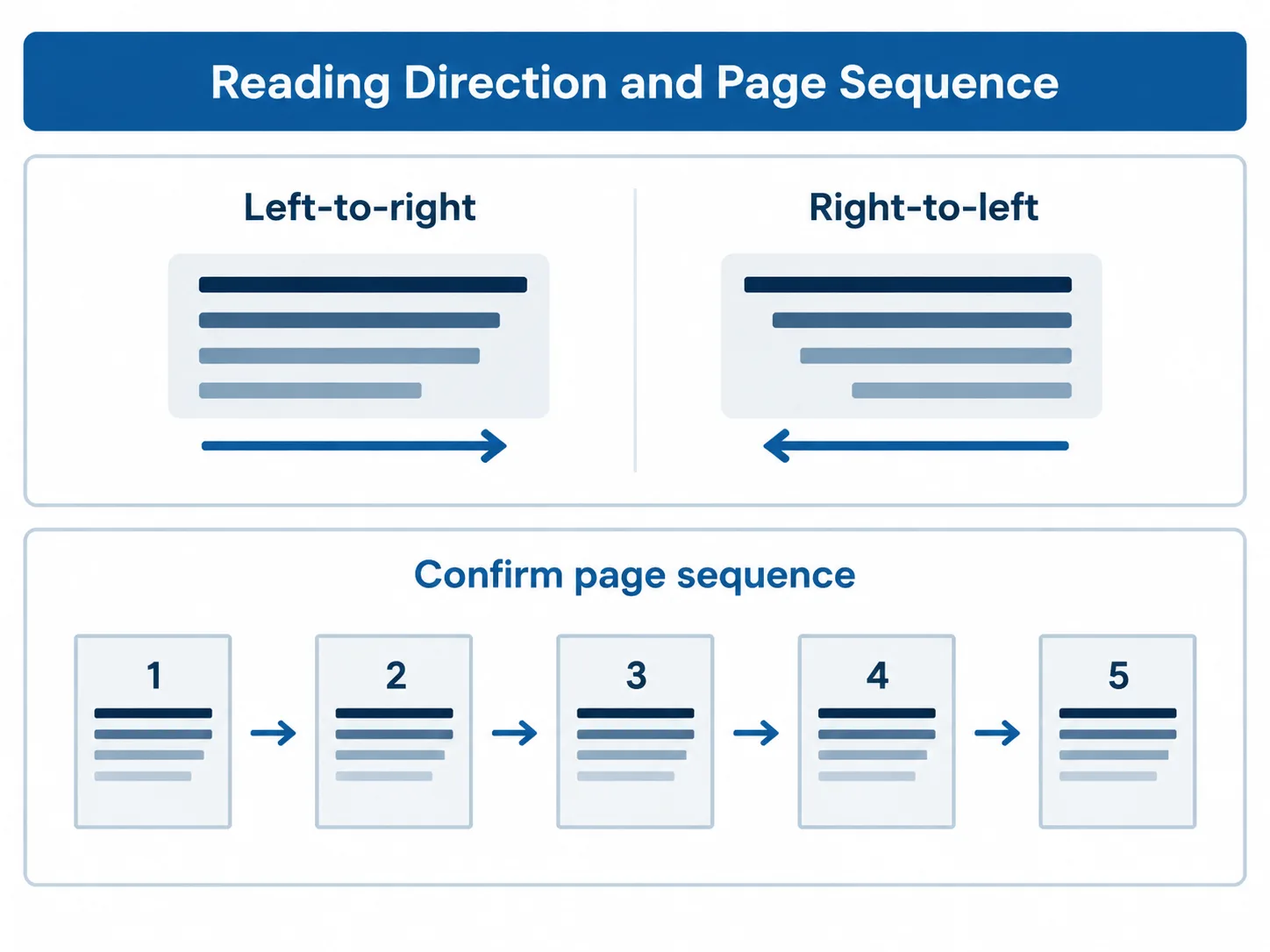
Specify text direction, page order and the book’s opening direction separately. A right-to-left text block does not automatically require the whole book to open from the opposite side.
For a mixed-direction language pair, agree which physical reading sequence the edition follows. Within each page, set paragraph direction correctly and inspect numbers, brackets, punctuation and embedded words from the other language. Manual spacing is an unreliable substitute for correct bidirectional text handling.
Make the sequence understandable through consistent language positions and clear section cues. Check page numbers, contents entries and vocabulary indexes where applicable.
Prepare a simple physical dummy with the cover and every page in sequence. Mark the intended front, spine side and first story page. Ask both language reviewers to use it as a reader would. Supply the approved sequence to the printer and follow its file-delivery instructions rather than rearranging pages into printer spreads yourself.
6. Coordinate Illustrations, Trim and Binding
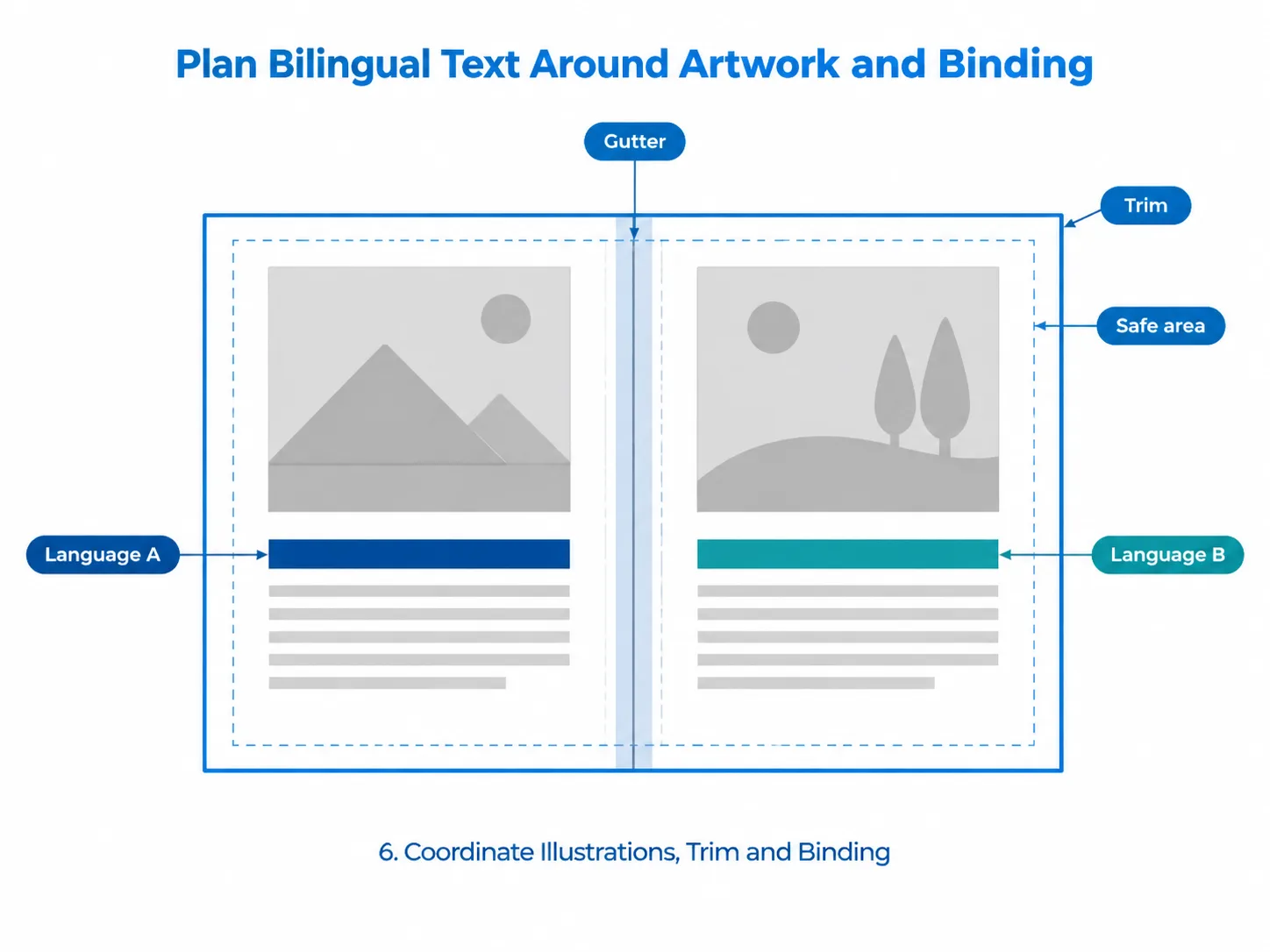
Reserve readable text areas in the artwork and keep important content clear of the gutter and trim. Two language blocks need intentional space, especially when illustrations span both pages.
Keep editable text separate from illustration files wherever practical. Words inside signs, speech bubbles and maps also require translation planning; overlooking them can leave an otherwise bilingual book partly untranslated.
Do not mirror an entire illustration simply because one language reads in the opposite direction. Mirroring can reverse embedded lettering, change meaningful gestures or disrupt story continuity. Review image adaptations with the illustrator and language editor.
Choose trim size and binding alongside the spread design. The usable inner margin depends on the construction and opening behavior. A hardcover case alone does not establish that a book will lie flat. Review our hardcover case material and cover options when specifying the exterior, then confirm the text-block construction separately.
Paper opacity and surface also affect readability. Check small text over artwork and inspect show-through on the reverse side using a representative paper sample or an appropriate production proof.
7. Approve Language and Production Proofs
Approve the language content and the production output through distinct checks. A technical file check cannot establish that a translation is accurate or appropriate for children.
- Editorial review: Have qualified reviewers approve meaning, reading level, names, punctuation and correspondence between passages.
- Layout review: Inspect the final exported PDF for overflow, missing characters, awkward breaks, language pairing and page order.
- Physical review: Use an actual-size printout or dummy to assess type size, page turns and text near the binding.
- Production review: Agree the proof or sample type with the printer and confirm what it represents, including color, stock, finishing and construction.
- Release approval: Identify the approved file version, resolve all corrections and retain the final approval record.
A screen proof can help check content and placement, but it does not demonstrate paper opacity or finished opening behavior. A color proof may use a different substrate from the production stock. Ask what each approval stage can verify.
Allow time for both language reviewers to respond. Late editorial changes can trigger repagination, renewed preflight and additional proofs, affecting the production schedule.
Book Formats and Their Layout Implications
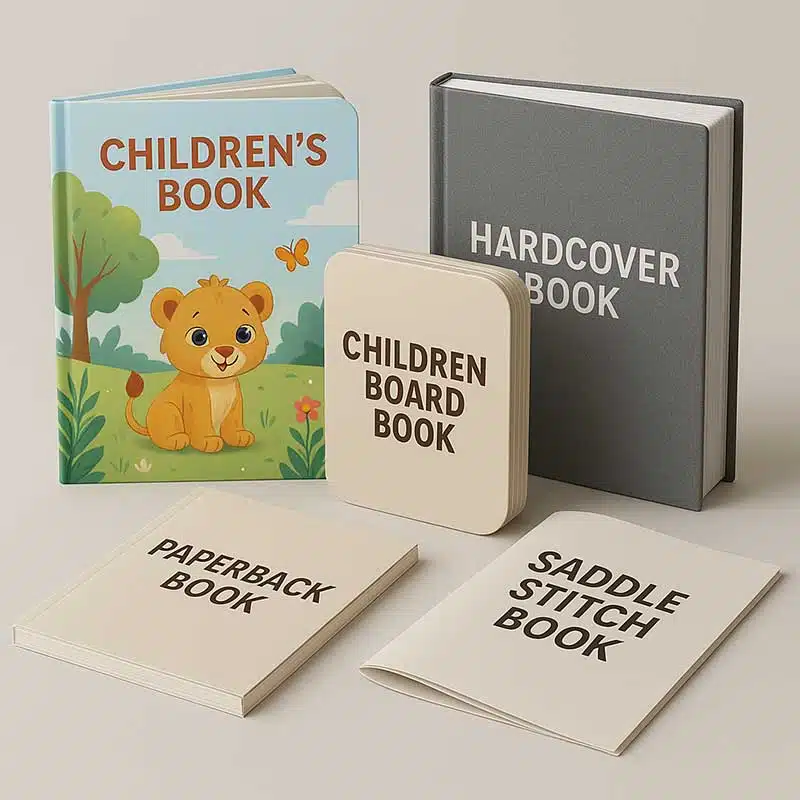
Compare physical formats by reading use and available page space. These are planning options, not fixed specifications; confirm construction, materials and page-count limits for your project.
| Product format | Typical reading use | Bilingual layout implication | Specification to confirm |
|---|---|---|---|
| Hardcover picture book | Shared reading and illustrated storytelling | Plan text around spread artwork and the inner margin | Text-block binding, opening behavior and case dimensions |
| Paperback early reader | Independent reading and classroom use | Preserve comfortable type size within a compact format | Binding suitability for the final page count and paper |
| Board book | Short, repeated reading for younger children | Keep both language passages brief and visually clear | Page construction, counting convention and safe areas |
| Saddle-stitched reader | Short lessons and simple stories | Allow for the agreed page-count increments and trim behavior | Stock thickness, page count and creep allowance |
Request comparisons using the same content, quantity and destination wherever possible. A smaller book may reduce some material requirements while creating a readability problem or requiring extra pages.
قائمة مراجعة للمشتري قبل طلب عرض الأسعار
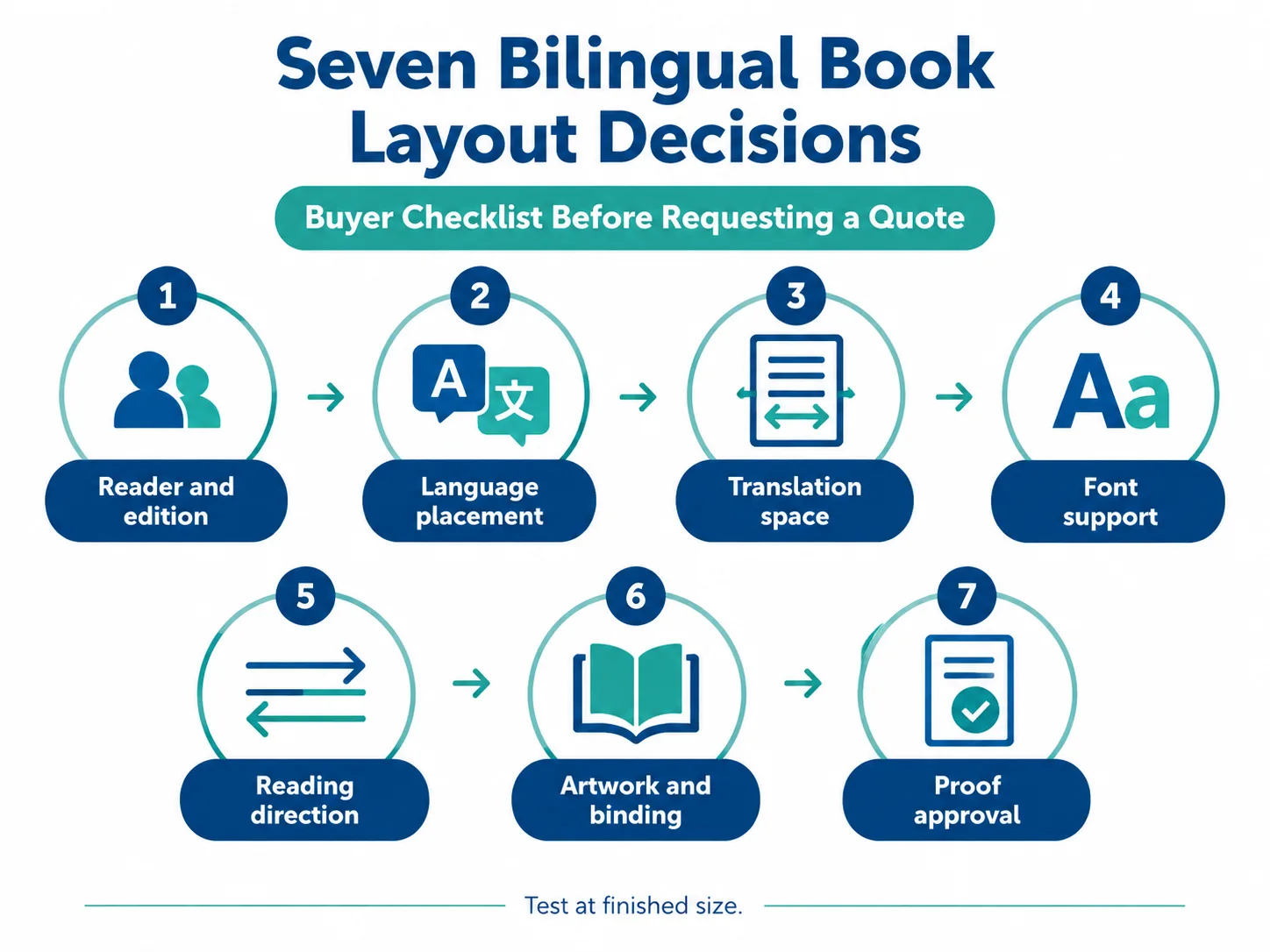
Send a specification that connects the language layout to the finished product. Clear inputs make quotations easier to compare and help identify unresolved production decisions.
- Language pair, target age and shared or separate edition structure.
- Finished trim size, orientation and proposed page count, stating how covers are counted.
- Quantity for each edition and destination country.
- Paper, binding and cover finish preferences, or options you want compared.
- Representative spreads showing the longest text and any mixed reading directions.
- Font readiness, translation approval and print-file status.
- Required proof stages, reviewer availability and intended launch timing.
Specification summary: Language placement governs the page grid; translation length governs space requirements; script support governs font selection; binding governs inner margins; proof scope governs what can be approved before production.
Distinguish a desired launch date from an agreed production and shipping schedule. File corrections, sample approval and transport arrangements can all affect timing.
Bilingual Book Printing FAQ
These answers address common questions about language placement, typography, reading direction and production planning.
Key Takeaways
A successful bilingual layout starts with the reader and the approved text. Choose a consistent language arrangement, test the longest passages, verify script support and confirm the physical reading sequence.
Keep illustrations and binding requirements in the same planning process. Before releasing files, obtain language approval and production approval for the final version. These decisions give bilingual book printing a clear specification and reduce avoidable redesign.
الأسئلة الشائعة
Should both languages appear on the same page?
Use the same page when readers need to compare passages or share one illustration. Facing pages or separate sections may suit uninterrupted reading better. Test the longest passages before choosing the arrangement.
What font size should a bilingual children's book use?
There is no universal size. Choose it for the reader age, script, font design and finished trim size. Compare both languages on an actual-size printout because equal point sizes can look different.
How much extra space should a translation receive?
Use the actual translated passages to determine space. Length changes vary by language pair and content. Test long passages and script-specific line spacing rather than applying one expansion percentage.
Can left-to-right and right-to-left languages share one book?
Yes, with deliberate paragraph direction, page sequence and navigation. Agree the physical opening direction, check mixed-direction punctuation and numbers, and approve a page-order dummy with both language reviewers.
Does bilingual printing automatically cost more?
Two languages do not inherently require a separate printing process. Costs can rise when the layout adds pages, changes size or construction, requires additional proofs, or divides quantities between editions. Compare quotations using consistent specifications.
هل أنت مستعد للتخطيط لمشروع الطباعة المخصص الخاص بك؟
Tell YBJ Printing about your bilingual book project. Share the product type, language pair, trim size, page count, quantity, paper or binding preferences, finish requirements, file status and destination country. Our team can discuss practical production options and prepare a factory-direct quotation based on your specifications.