

In the world of custom manufacturing, few industries are as unforgiving as professional printing. Unlike digital products that can be updated instantly, offset and digital printing are physical, permanent processes. Once the ink hits the paper and the die-cutters strike, any error becomes a costly waste of materials and time. For international buyers sourcing from a Usine d'impression en Chine, understanding the printing quality control (QC) process is not just technical trivia—it is a critical safeguard for your brand’s reputation.
Whether you are producing custom board games, tarot cards, or rigid packaging boxes, the difference between a premium product and a rejected shipment often lies in the rigor of the factory’s inspection protocols. This guide details the standard QC steps a professional printer should follow, from file preparation to final logistics, ensuring your project meets global standards.
1. Pre-Press Quality Control: The First Line of Defense

Quality control begins long before the printing plates are made. The pre-press stage is where the vast majority of potential errors—such as low-resolution images or incorrect fonts—are caught. A professional factory will not simply hit “print” on your files; they will perform a comprehensive file audit.
File Verification and Flight Checks
Pre-press engineers use specialized software to check digital assets against production requirements. Key checkpoints include:
- Résolution : Ensuring all images are at least 300 DPI to prevent pixelation.
- Mode couleur : converting RGB files (screen color) to CMYK (print color) to avoid unexpected color shifts.
- Bleed and Safety Margins: Verifying that artwork extends beyond the trim line (usually 3mm) so that minor cutting shifts do not leave white edges.
- Font Embedding: Ensuring all fonts are outlined or embedded to prevent substitution errors.
Digital vs. Hard Copy Proofing
Before mass production, the factory should provide a proof. A PDF proof is standard for checking text and layout, but it cannot accurately predict color output on different monitors. For color-critical projects, a hard copy proof (or GMG color proof) is essential. This physical sample is calibrated to simulate the final press output, serving as the “contract proof” that the production team must match.
2. On-Press QC: Managing Color and Consistency
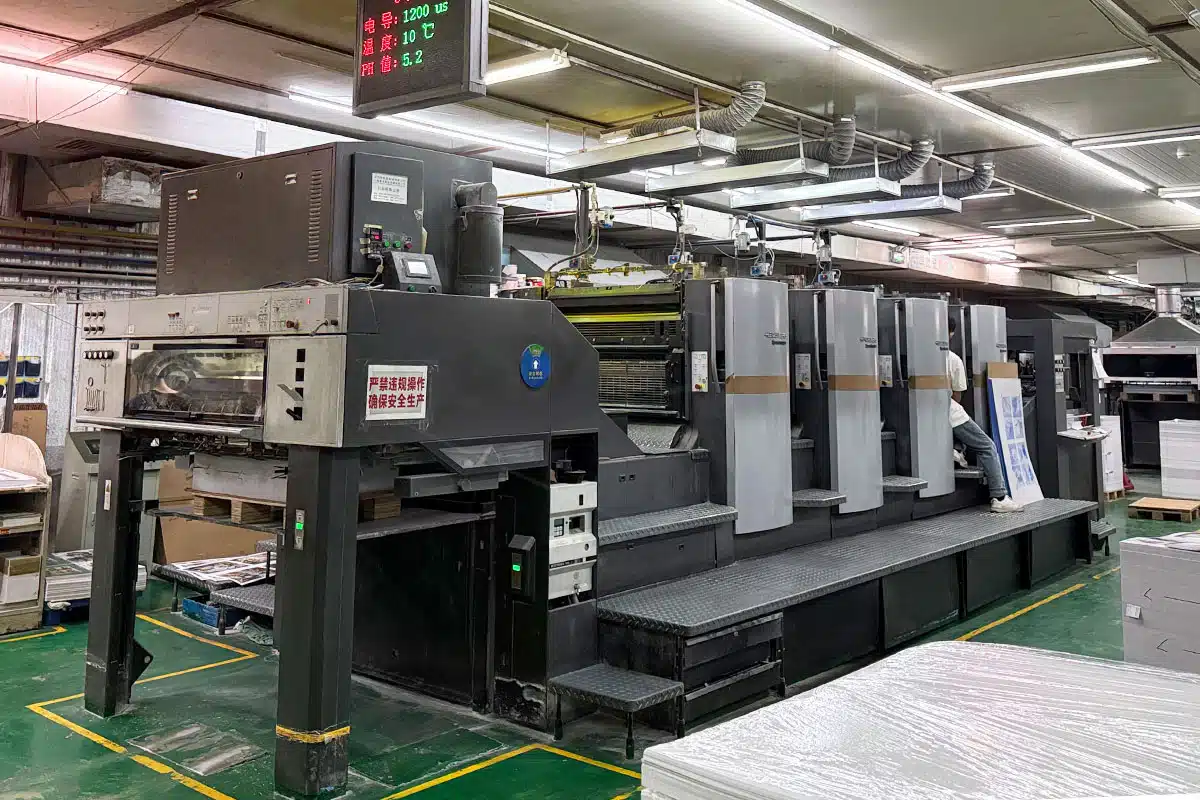
Once the job is on the press, the focus shifts to color management and mechanical precision. High-speed offset presses require constant monitoring to ensure consistency from the first sheet to the ten-thousandth.
Color Management Standards
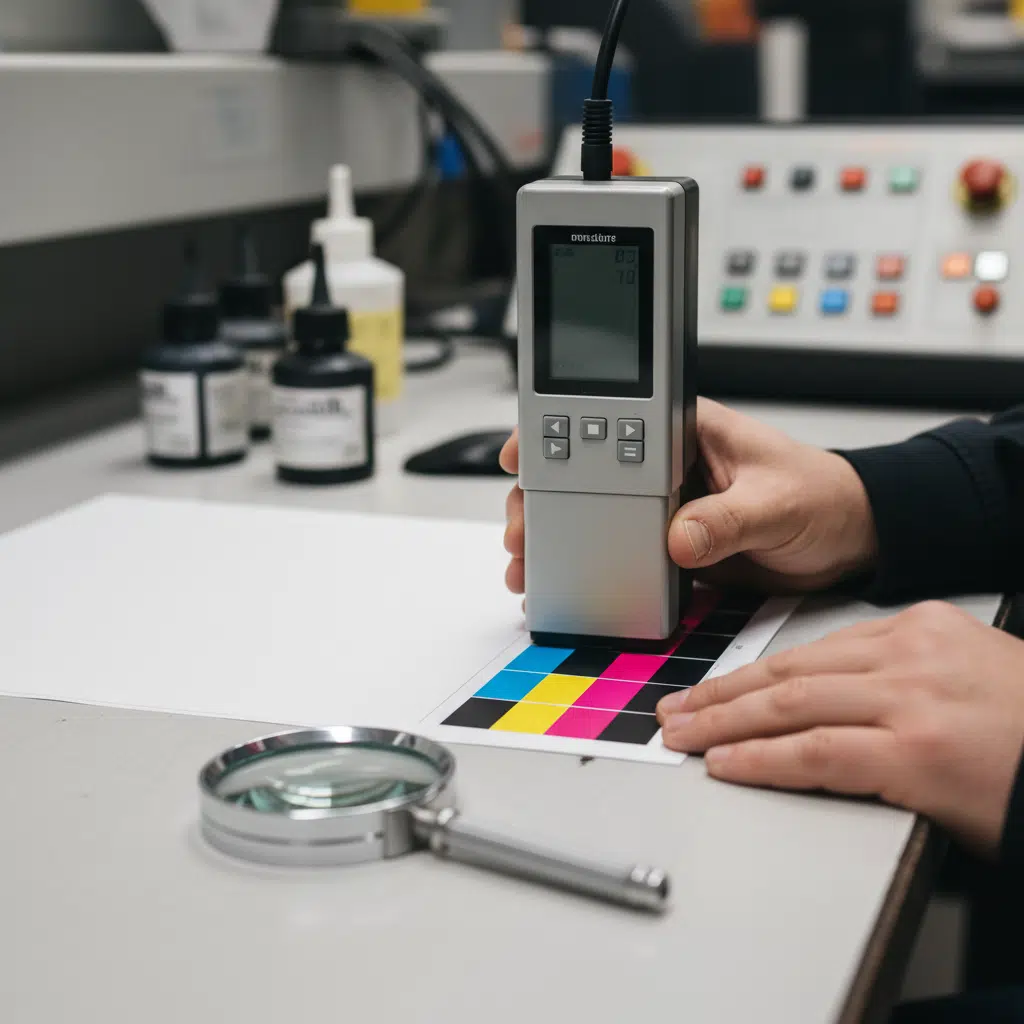
Professional printers rely on objective data, not just the human eye. Press operators use spectrophotometers et densitometers to measure color bars printed on the edge of the sheet. These tools analyze:
- Ink Density: Ensuring the ink layer is thick enough to produce vibrant colors without smudging.
- Dot Gain: Monitoring how much ink spreads as it hits the paper, which can darken images if uncontrolled.
- Color Matching: Verifying adherence to ISO 12647-2 standards or specific Pantone (PMS) references.
Registration and Alignment
Registration refers to the precise alignment of the four process colors (Cyan, Magenta, Yellow, Black). If these plates are even a fraction of a millimeter out of sync, the image will look blurry or have colored halos. Operators pull sheets frequently during the run to check registration marks and adjust the press cylinders immediately if drift occurs.
3. Post-Press and Finishing Inspections
Printing is often just the beginning. Post-press processes—such as lamination, foil stamping, die-cutting, and gluing—introduce new variables that require strict printing inspection.
Surface Finishing Checks
If your project involves lamination (gloss, matte, or soft-touch) or UV coating, QC inspectors check for bubbles, peeling, or scratches. For foil stamping, they ensure the foil edges are crisp and that the foil adheres properly without flaking.
Die-Cutting and Assembly Accuracy
For packaging and board games, dimensional accuracy is paramount. A box that is 1mm too small may not fit its contents, while a deck of cards with rough edges will shuffle poorly. Inspectors measure the final cut dimensions against the structural dieline. In assembly lines (e.g., gluing rigid boxes), workers check for excess glue residue and ensure that corners are wrapped tightly and neatly.
4. Final Quality Assurance: AQL Standards
Before goods are packed for shipment, a final audit is conducted. Since inspecting every single unit in a run of 50,000 is often impractical, professional factories use the Acceptable Quality Limit (AQL) standard (typically ISO 2859-1).
Understanding AQL Levels
AQL determines the sample size for random inspection and the maximum number of defects allowed before the entire batch is rejected. Defects are categorized as:
- Critical Defects: Issues that render the product unusable or unsafe (e.g., sharp edges, mold, incorrect text). Tolerance is usually 0.
- Major Defects: Issues that affect functionality or saleability (e.g., significant color variation, smashed corners).
- Minor Defects: Slight imperfections that do not affect usability (e.g., a tiny scratch on the back of a box).
International buyers should define their AQL expectations (e.g., Level II, AQL 2.5 for major defects) in the purchase agreement to align expectations with the factory.
5. Common Printing Defects to Watch For
When reviewing samples or receiving a shipment, knowing what to look for helps you communicate effectively with your supplier. Common issues include:
- Hickeys: Small spots or halos caused by dust or dried ink on the printing plate.
- Banding: Visible horizontal or vertical lines in solid color areas.
- Offsetting: Ink from one sheet transferring to the back of the sheet above it (often caused by insufficient drying time).
- Ghosting: A faint image reappearing on the sheet due to ink starvation on the rollers.
6. Buying Guide: Ensuring Quality with Your Partner
Achieving high-quality results is a collaborative effort. Here is how you can support the QC process:
Define Specifications Clearly
Ambiguity is the enemy of quality. Specify paper weight (GSM), grain direction, specific Pantone codes, and coating types clearly in your RFQ. If you require a specific testing standard (e.g., rub resistance testing for shipping boxes), state this upfront.
Request Production Samples
Always request a “pre-production sample” (PPS) made on the actual equipment if possible, or at least a digital sample for content approval. For large orders, requesting a “top of production” sample (the first few units off the line) allows you to catch issues before the full run is finished.
FAQ: Printing Quality Control
What is the difference between RGB and CMYK in printing?
RGB (Red, Green, Blue) is used for digital screens and creates color with light. CMYK (Cyan, Magenta, Yellow, Key/Black) is used for printing and creates color with ink. Submitting RGB files can result in duller colors when printed, so professional QC teams will convert them to CMYK during pre-press.
Can I inspect the goods while they are in China?
Yes. Many international buyers hire third-party inspection agencies to visit the factory and perform an AQL inspection before the final balance payment is made. Reputable factories welcome this transparency.
Why does the printed color look different from my screen?
Screens emit light, making colors appear brighter and more saturated. Paper reflects light, and the texture of the paper affects how ink absorbs. A calibrated hard copy proof is the only accurate way to predict final color.
What is a “press check”?
A press check involves the client visiting the factory to approve the first sheets coming off the press. While effective, it is costly for international buyers. Remote approval via high-resolution photos or video calls is a common alternative.
How do you ensure color consistency across reprints?
Factories keep “retain samples” from previous runs and store the approved color values. When a reprint is ordered, operators match the new run to the approved sample from the previous batch to ensure brand consistency.
Conclusion
Quality control in printing is a blend of technology, craftsmanship, and rigorous process management. From the initial file check to the final random inspection, every step is designed to minimize risk and maximize impact. By understanding these processes, you can vet potential partners more effectively and ensure your printed materials reflect the quality of your brand.
Ready to start your next project with a partner committed to precision? Demande de devis or get a sample from YBJ Printing today to see our quality control in action.