
Manufacturing High-Quality Activity Books for Publishers
For educational publishers and toy brands, custom sticker books represent a unique manufacturing challenge. Unlike standard picture books, sticker books require precise coordination between adhesive chemistry, substrate selection, and mechanical die-cutting tolerances. A slight deviation in blade pressure can result in stickers that tear upon removal or, conversely, cut through the backing page, ruining the book’s integrity.
This guide explores the technical specifications involved in custom sticker book printing. We examine the tradeoffs between permanent and reusable adhesives, the mechanics of kiss-cutting within a bound format, and the material choices that ensure a durable, high-value product for the end-user.
Adhesive Technologies: Permanent vs. Reusable
The functionality of a sticker book depends largely on the adhesive formulation. The choice between permanent and reusable options dictates the substrate material and the manufacturing cost.
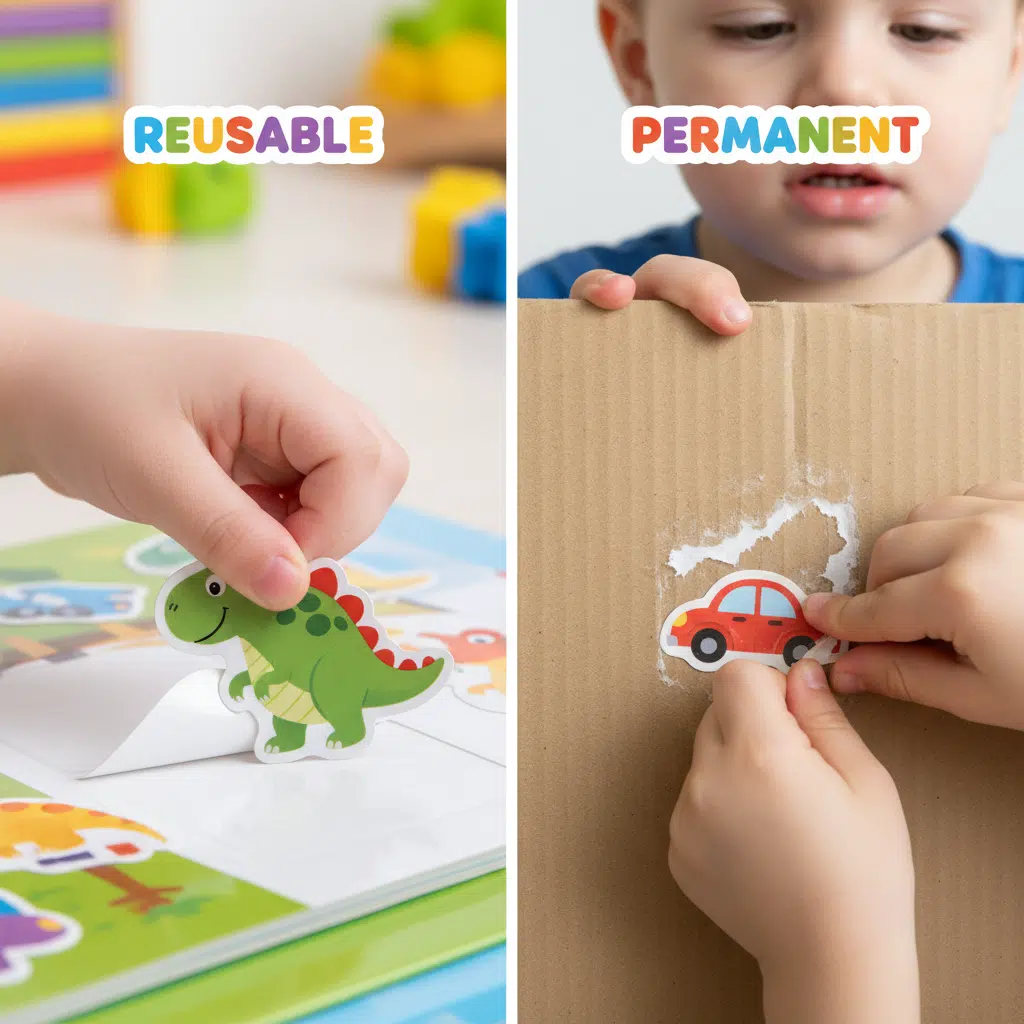
1. Low-Tack Removable Adhesive (Reusable)
Reusable stickers are the industry standard for interactive activity books where children create scenes or move characters. These rely on low-tack pressure-sensitive adhesives (PSA) or static cling technology.
- Low-Tack PSA: This uses a microsphere adhesive that allows the sticker to be peeled and re-stuck multiple times without leaving residue or tearing the paper fibers. It works best on coated, glossy pages (the “scene” pages) inside the book.
- Static Cling (Vinyl): These contain no adhesive. They rely on the static charge between smooth vinyl and a glossy surface. While highly reusable, they are more expensive and generally require the sticker material to be PVC or a similar plastic, rather than paper.
2. Permanent Adhesive
Permanent adhesive is typically used for reward books, collecting albums, or educational workbooks where the sticker is meant to be placed once (e.g., answering a question or sealing a page). These adhesives cure stronger over time. Publishers must ensure the face stock (the sticker paper) is thick enough to prevent tearing when the user removes it from the release liner.
The Precision of Kiss-Cutting
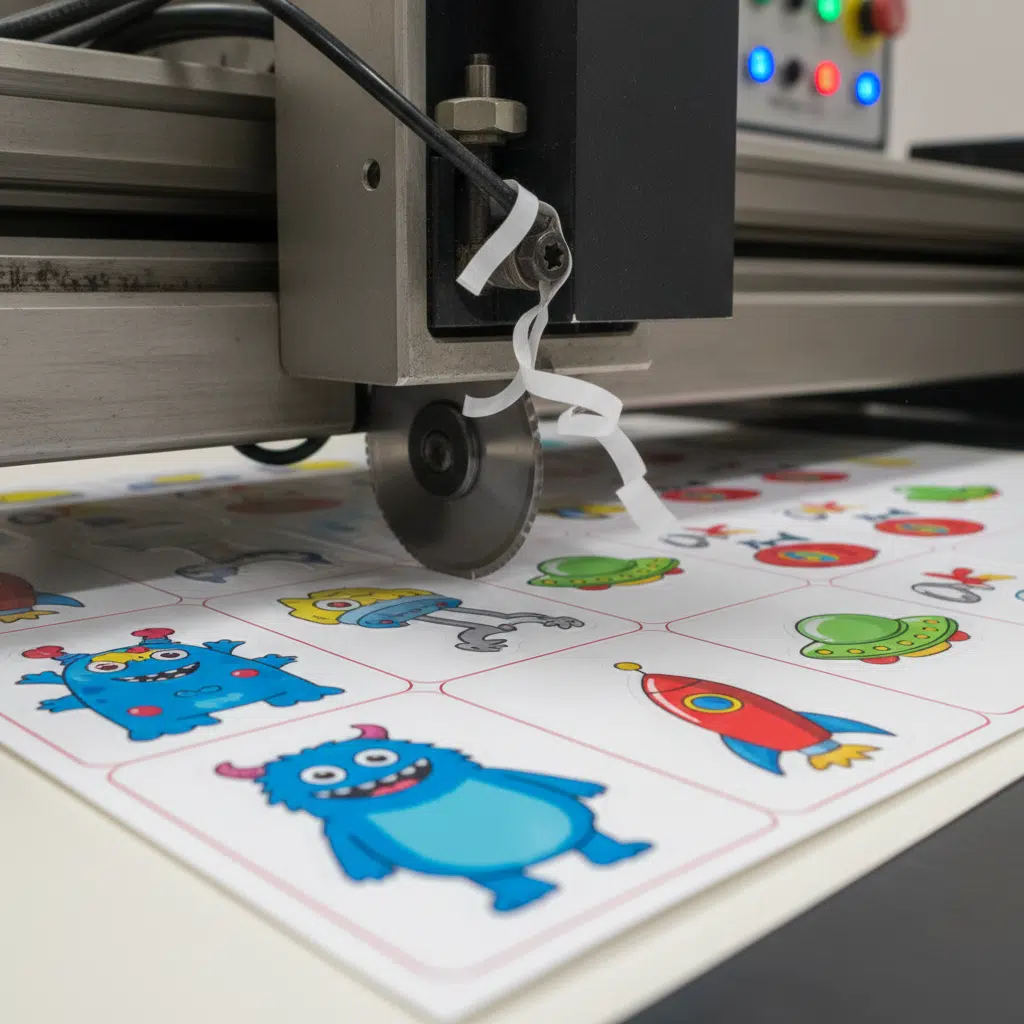
The defining feature of a sticker page is the “kiss cut.” In this process, the die-cutting blade slices through the face stock and adhesive layer but stops precisely at the silicone release liner (backing paper).
Technical Challenges in Bound Books
Kiss-cutting for loose sticker sheets is straightforward, but sticker books add complexity:
- Registration Accuracy: The print image and the cut line must align perfectly. Standard industry tolerance is typically ±0.5mm. If the registration drifts, the sticker design will be off-center.
- Blade Depth Control: If the blade cuts too deep (die strike-through), the backing paper weakens. In a bound book, a cut-through backing page can cause the sheet to fall out of the binding (especially in saddle-stitched books) or tear when the user turns the page.
- Matrix Removal: For premium sticker books, the “matrix” (the waste paper surrounding the stickers) can be stripped away during manufacturing. This makes it easier for small children to peel the stickers. However, keeping the matrix intact is more cost-effective and protects the sticker edges during the binding process.
Paper Stocks and Release Liners
Selecting the right combination of face stock and release liner is critical for flat-laying books.
| Component | Common Options | Application Notes |
|---|---|---|
| Face Stock | Gloss Art Paper, Woodfree Paper, Vinyl (PVC/PET) | Gloss provides vibrant color for characters. Woodfree (uncoated) is used if stickers need to be written on. |
| Release Liner | White or Yellow Silicone Paper (80gsm – 140gsm) | Heavier liners (100gsm+) are preferred for books to prevent curling and ensure pages turn easily. |
Binding Compatibility
Sticker pages are thicker than standard text pages. When planning the pagination (page count), publishers must account for this spine bulk.
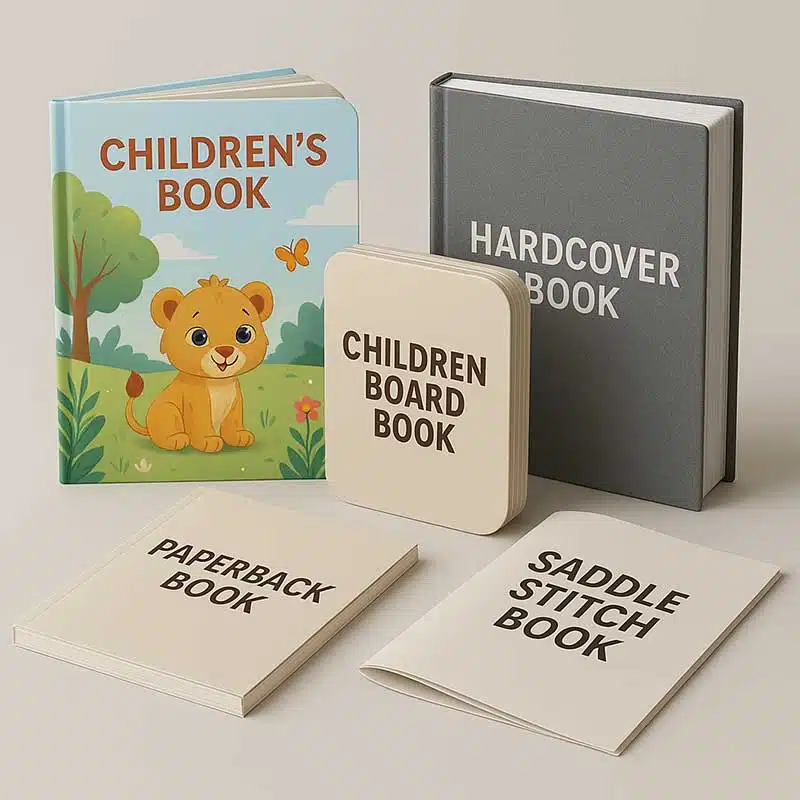
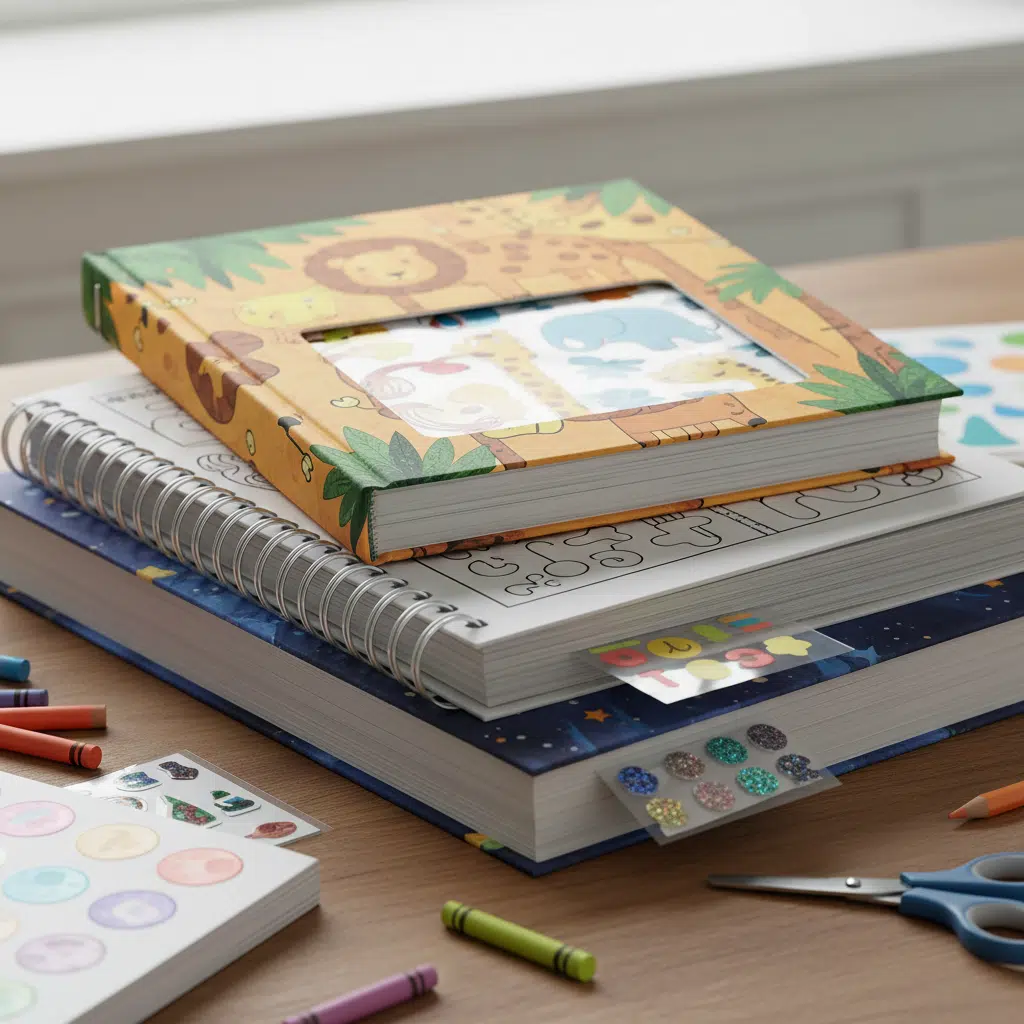
- Saddle Stitching: Ideal for thinner activity books (e.g., 16-32 pages). Sticker sheets are usually inserted as the center spread or tipped in.
- Perfect Binding: Better for high-page-count compilations. Sticker pages must be glued securely; however, the silicone coating on release liners repels standard glue. Specialized roughing or non-coated margins are required at the spine edge to ensure the pages do not fall out.
- Wire-O / Spiral: The best option for lay-flat usability. It easily accommodates the varying thickness of sticker pages versus coloring pages without spine tension issues.
Pre-Press and Artwork Considerations
To ensure a smooth manufacturing process, artwork files must be prepared with specific layers.
Dielines and Bleed
The “dieline” is the vector path that tells the machine where to cut. This should be supplied as a separate spot color layer (often named “Dieline” or “CutContour”) in the PDF.
- Bleed: Extend the artwork 2mm–3mm beyond the cut line. This ensures that if the cutter shifts slightly, there is no white edge on the sticker.
- Safety Margin: Keep important text or design elements at least 2mm inside the cut line to prevent them from being clipped.
Quality Assurance and Safety Testing
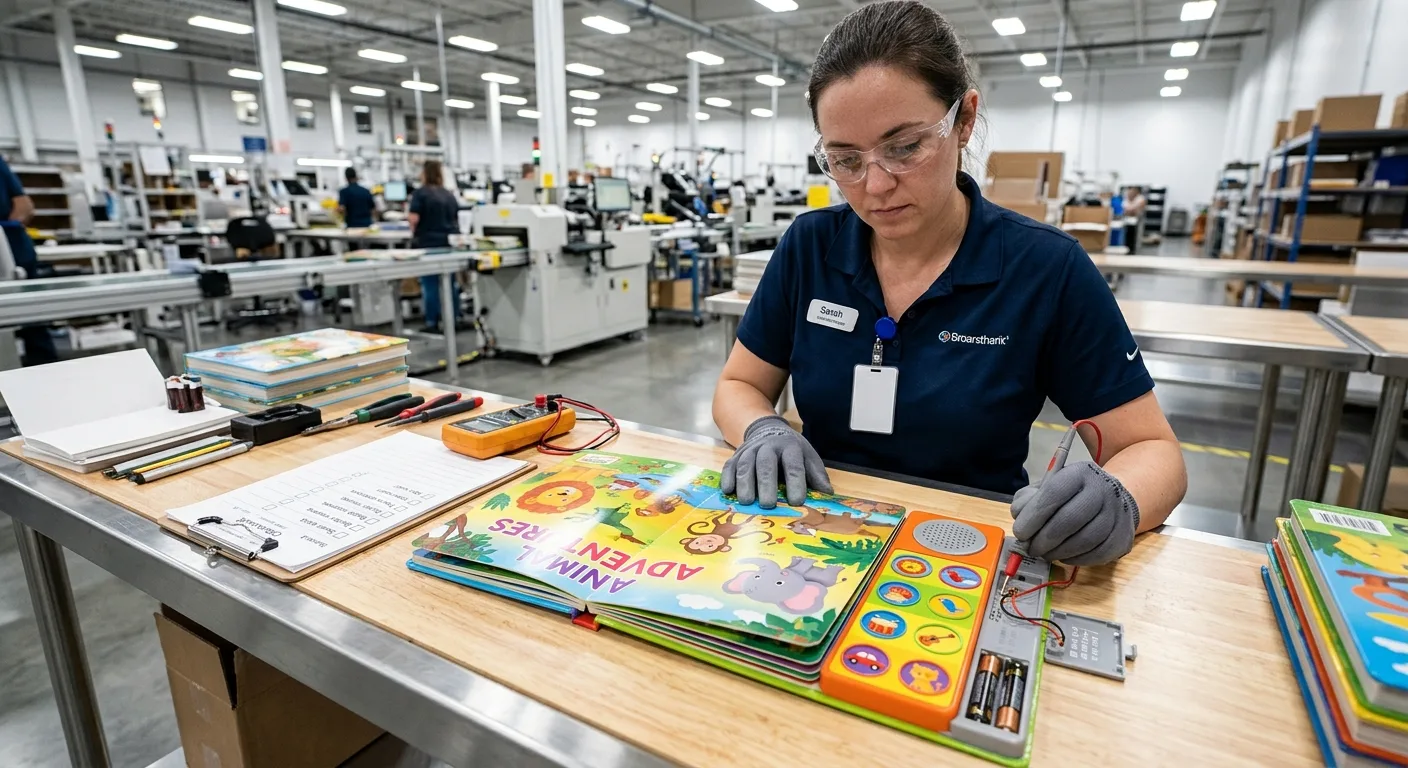
For children’s products, safety is non-negotiable. Custom sticker book printing must adhere to international safety standards such as EN71 (Europe) and ASTM F963 (USA).
- Non-Toxic Inks: All inks and adhesives must be lead-free and non-toxic.
- Choking Hazards: While stickers themselves are generally safe, very small stickers or plastic components must be evaluated for age appropriateness.
- Adhesion Testing: Manufacturers should perform aging tests to ensure removable stickers do not become permanent over time due to heat or pressure during shipping.
Buying Guide: Ordering Custom Sticker Books
When requesting a quote for sticker book manufacturing, clarity on specifications will result in more accurate pricing and timelines.
- Dimensions: Standard A4 or custom sizes.
- Page Count: Specify the number of text/coloring pages versus sticker sheets.
- Adhesive Type: Clearly state if stickers must be reusable or permanent.
- Binding: Saddle stitch, perfect bound, or wire-o.
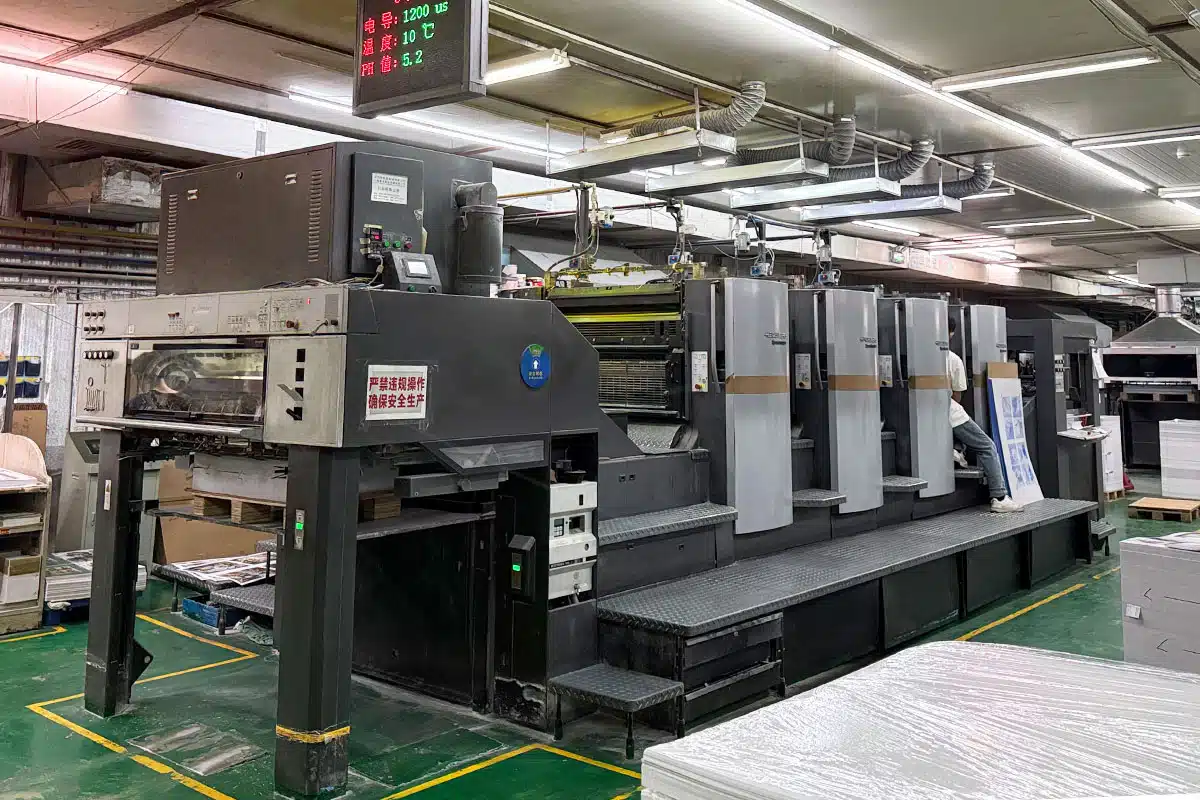
- Quantity (MOQ): Offset printing typically requires a Minimum Order Quantity (often 500–1,000 units) to be cost-effective due to setup times for dies and plates.
FAQs
Can I mix sticker pages with normal coloring pages?
Yes, this is the most common format. Sticker sheets are often tipped in or bound into the center of the book. For perfect bound books, they can be distributed throughout, provided the spine glue is compatible.
What is the difference between kiss cut and die cut?
In the context of stickers, a “kiss cut” cuts only the top sticker layer, leaving the backing intact so it stays in the book. A “die cut” (or through cut) would cut through the backing as well, which is used for individual loose stickers, not bound pages.
Do I need to make a custom die mold?
Yes, unless you are using standard shapes (circles/squares) that the factory already has, a custom cutting die (mold) is created based on your vector dielines. This is a one-time tooling cost.
Are reusable stickers made of paper or plastic?
They can be both. “Static cling” stickers are vinyl (plastic). “Removable adhesive” stickers can be paper or film (PP/PET). Paper is more eco-friendly but less durable for repeated peeling than film.
Ready to launch your activity book project?
Contact us today to discuss material options and get a custom quote for your sticker book printing needs.