
Table of Contents
- What Is Interactive Board Book Printing?
- Choose the Right Interactive Features
- Designing Lift-the-Flap Board Books
- Die-Cut Windows and Shaped Board Books
- Touch-and-Feel Features for Board Books
- Buyer Checklist for Production
- What Affects Cost, Quality and Lead Time?
- Conclusion
Interactive board book printing combines durable board pages with physical features such as lift-the-flaps, die-cut openings and tactile materials. This guide explains how buyers can select, design and specify these features for practical production.
What Is Interactive Board Book Printing?
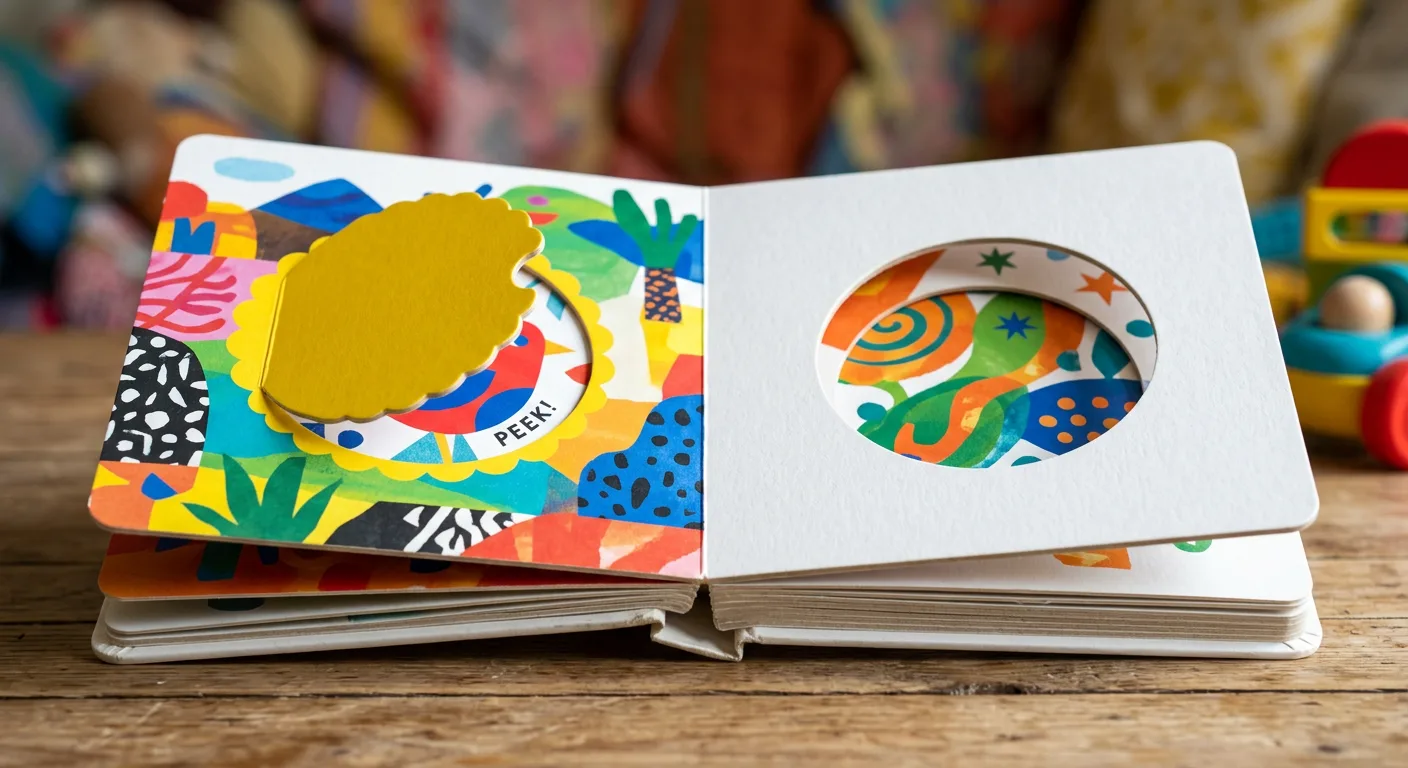
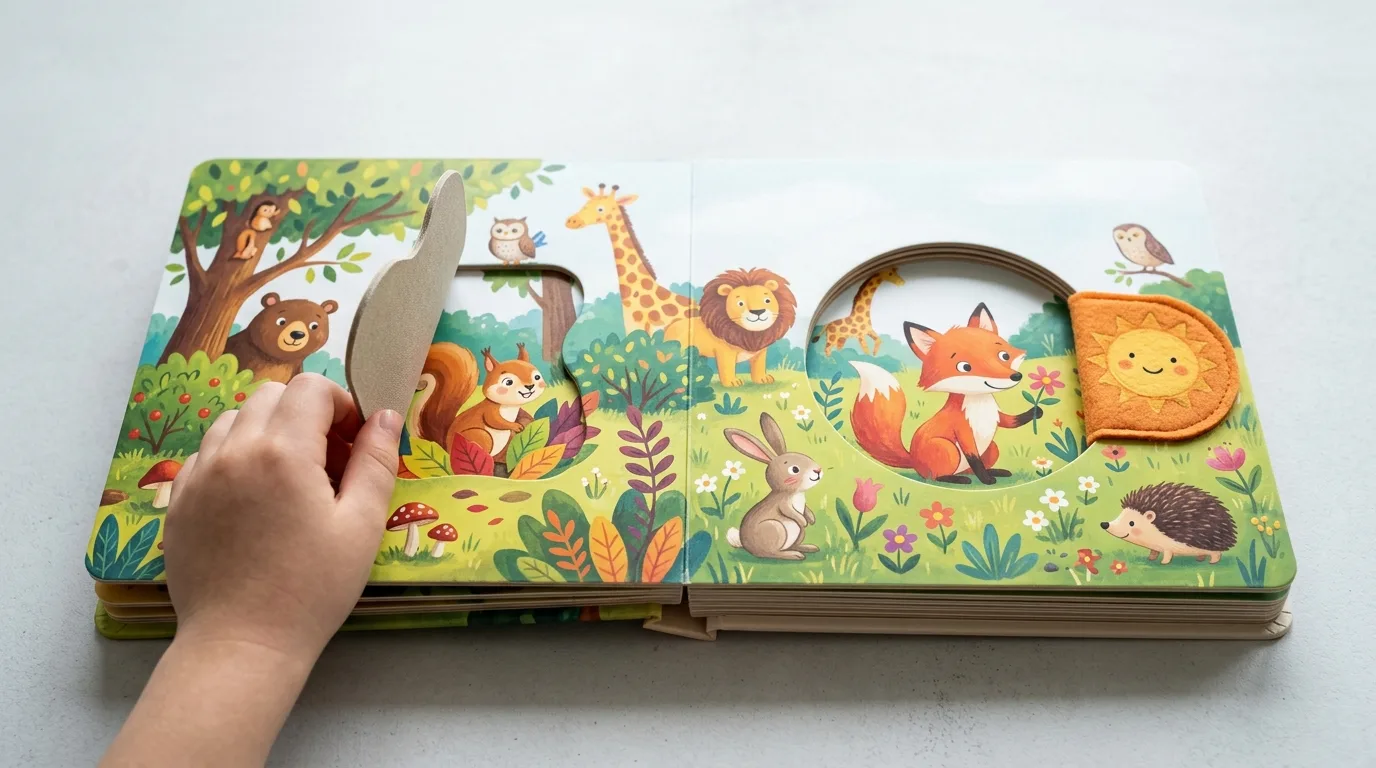
Interactive board book printing is the production of durable children’s books that incorporate physical actions or sensory elements into board pages. Common formats include lift-the-flap reveals, die-cut windows, shaped pages, and touch-and-feel materials. These features turn an illustration or story moment into an action that a young reader can explore.
Unlike a standard board book, an interactive format must be planned as a printed product and an assembled object. The artwork needs to account for folds, hidden images, cut lines, glue areas, material thickness and safe handling. Decisions made during concept development directly affect usability, unit cost, production complexity and the final packed size.
For publishers, educational brands and children’s product teams, the best feature is usually the one that supports a clear reading or learning purpose. A flap may create a question-and-answer reveal; a die-cut can frame a changing scene; and a tactile patch can reinforce concepts such as smooth, soft, rough or fuzzy.
Start by confirming the intended age group, the number of interactive elements, the expected quantity and the destination market. Then select a board book format that leaves enough space for each feature. Our guide to board book sizes and page counts can help you match the physical format to the content plan.
Choose the Right Interactive Features
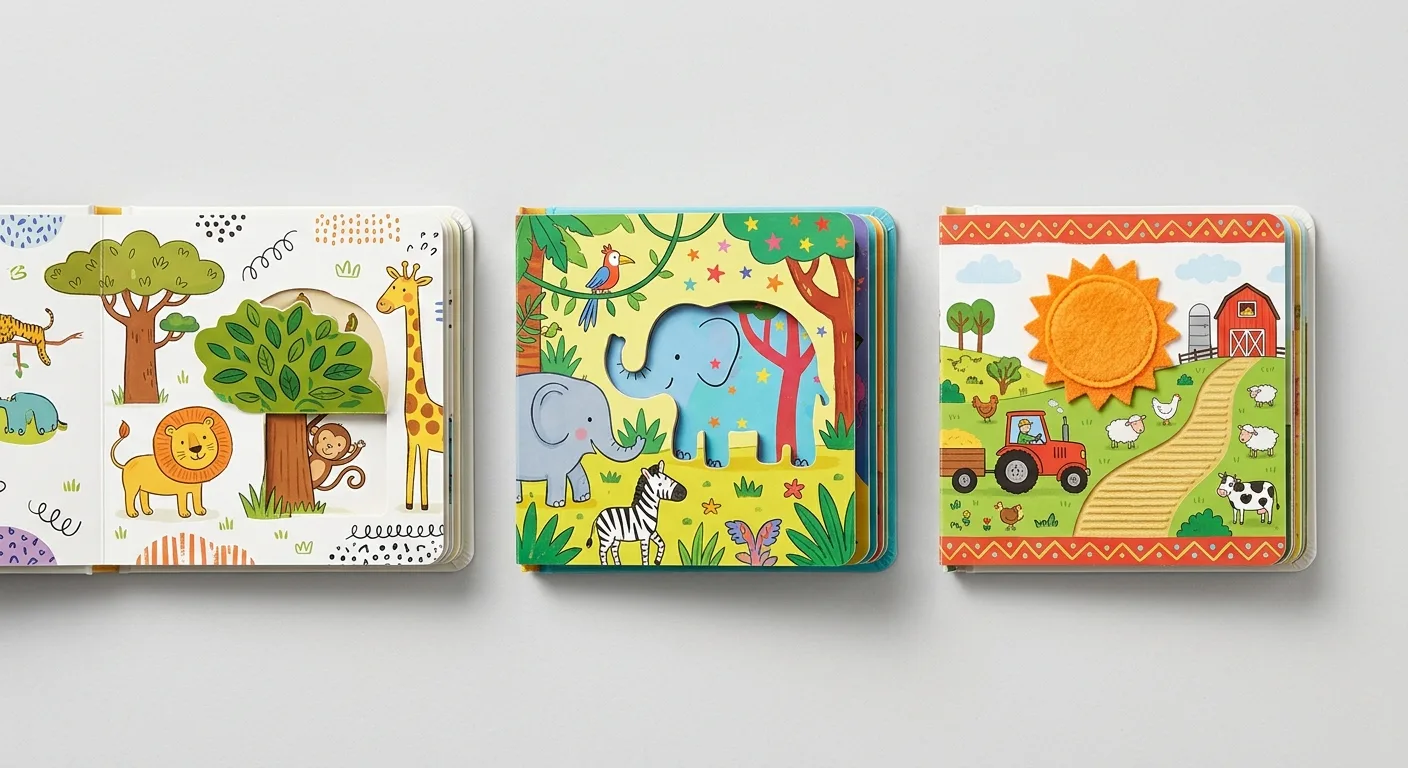
Each interactive feature creates a different reading experience and manufacturing requirement. Choosing early avoids redesigning pages after the illustration, copy and pagination are complete.
Lift-the-flaps
Flaps conceal an image, word or answer and invite a repeated action. They work well for guessing games, animal homes, routines, counting and simple narrative surprises. A flap can be a separate board component attached to a page, or it can be engineered as part of a larger construction. The attachment area, opening direction and finger access all need careful consideration.
Die-cut openings
Die-cuts remove board to create windows, peek-through effects or layered visual transitions. They can appear on one page or align through several pages. The design must preserve enough board around the opening to maintain page strength. Fine details, narrow bridges and cuts too close to a fold can be less practical than simpler, broader forms.
Touch-and-feel elements
Tactile patches add a sensory contrast to an illustration. Depending on the design, these may use fabric, flocked material, textured paper or other suitable applied materials. They need secure placement, clean edges and artwork that accommodates the material rather than treating it as an afterthought.
Some projects combine features, such as a flap that opens onto a textured surface or a die-cut window that reveals the next spread. Combining features can create a strong result, but every additional process adds design coordination, assembly steps and quality-control points. For a tactile-focused project, review this practical guide to manufacturing touch-and-feel books before finalising the concept.
Designing Lift-the-Flap Board Books
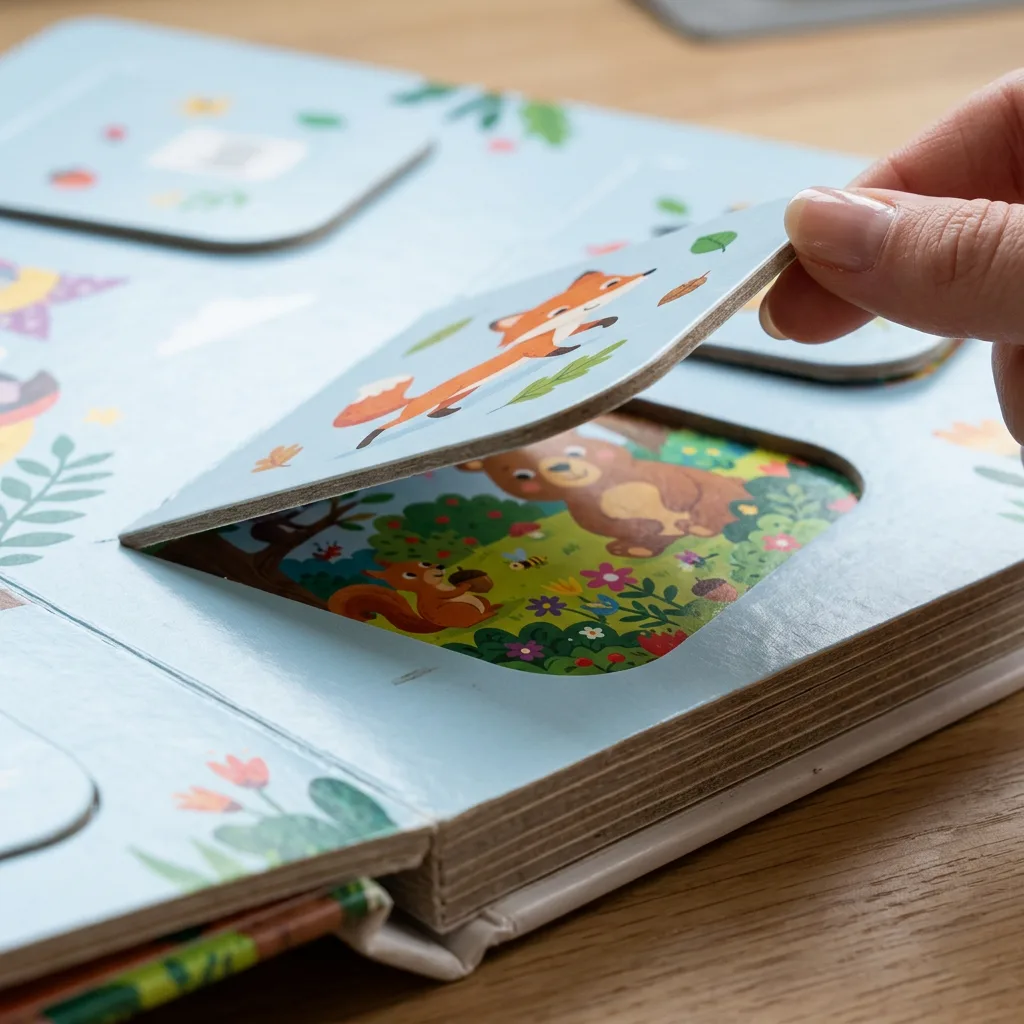
A successful lift-the-flap book makes the action obvious, easy to repeat and relevant to the content. The flap should have a visible opening cue, such as a tab, rounded edge or clearly accessible overhang. Avoid placing essential text or tiny artwork where a child’s fingers will repeatedly rub the surface.
Flap orientation matters. A top-opening flap often feels natural for a reveal below, while side-opening flaps can suit doors, cupboards or scene transitions. Consider how the flap behaves when the book is held upright, laid flat or turned quickly. The open flap should not obscure the answer or create an awkward reading sequence.
Board thickness and flap size need to be balanced. A very large flap may put greater stress on its attachment area, while a very small flap may be difficult to lift. Rounded corners and practical die-cut shapes are generally easier to handle than sharp, intricate profiles. The printed image beneath the flap should be complete and correctly aligned with the closed-page artwork.
Artwork files should identify every cut line, crease or fold line, glue area and component position on a separate clearly named technical layer. Keep these production guides distinct from visible artwork. It is also useful to supply a simple page-by-page interaction map that states what opens, in which direction and what the reader sees underneath.
For deeper construction guidance, see our article on engineering lift-the-flap books with die-cutting and assembly. A physical dummy or pre-production sample is particularly valuable when a project contains several flap styles or unusually large moving pieces.
Die-Cut Windows and Shaped Board Books
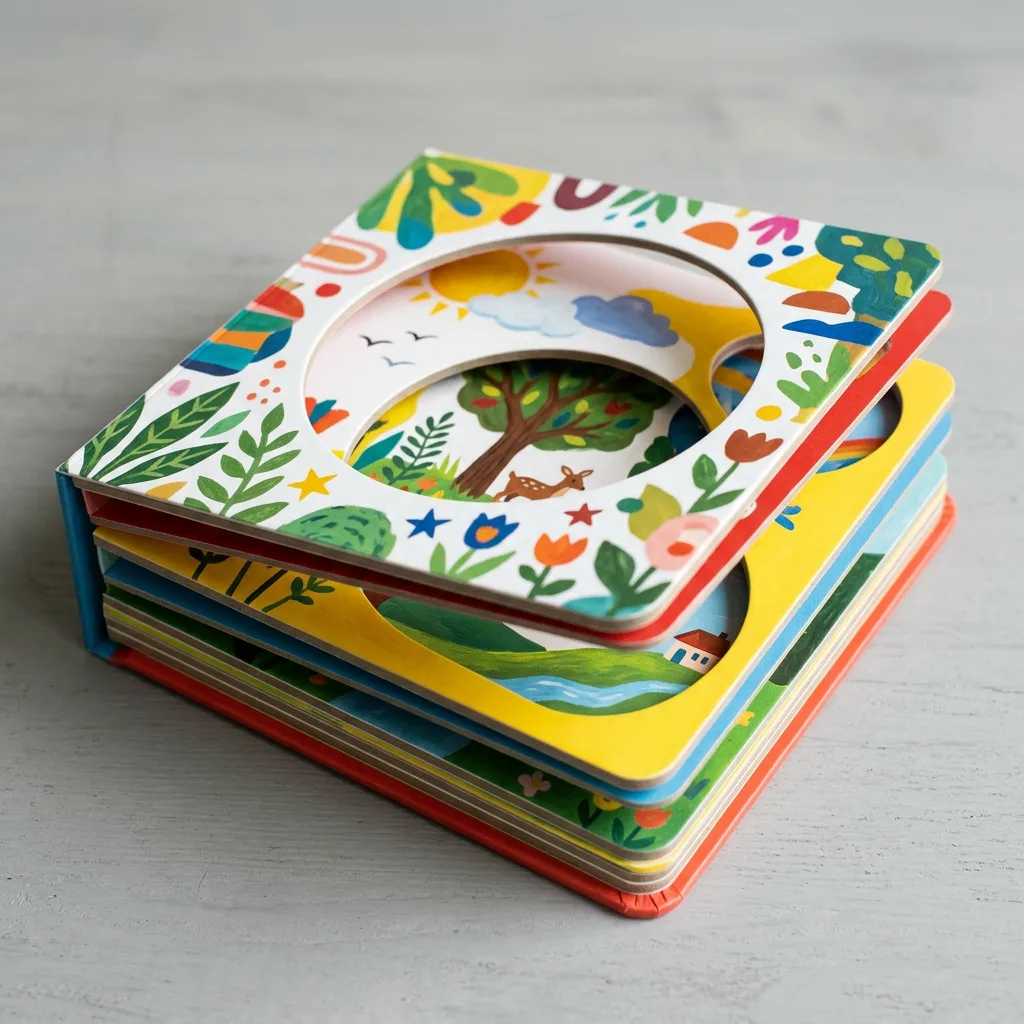
Die-cutting gives a board book a physical silhouette or creates openings within its pages. A window can introduce a character before a page turn, show a detail from the next spread or form part of a visual sequence. A shaped outer edge can make the whole book resemble an animal, vehicle, object or logo-led concept.
The main technical principle is structural integrity. Board surrounding a cut-out needs enough width to remain stable through packing, transport and repeated handling. Large openings may be practical, but the page layout should avoid thin unsupported areas. When an opening continues through multiple leaves, registration between pages becomes especially important because the reader will see the alignment of each layer.
Designers should also allow for the fact that a die-cut is a physical cut, not a digital line. Small internal details may not reproduce as intended, and narrow points can be vulnerable. A production-ready dieline should show the final trim, all cut paths and any safe zones needed for text and key images.
If the outside shape is central to your product concept, explore our custom die-cut shaped board book printing service. Sharing your intended size, page count and reference artwork early allows the production team to assess whether the shape and internal layout work together.
Touch-and-Feel Features for Board Books
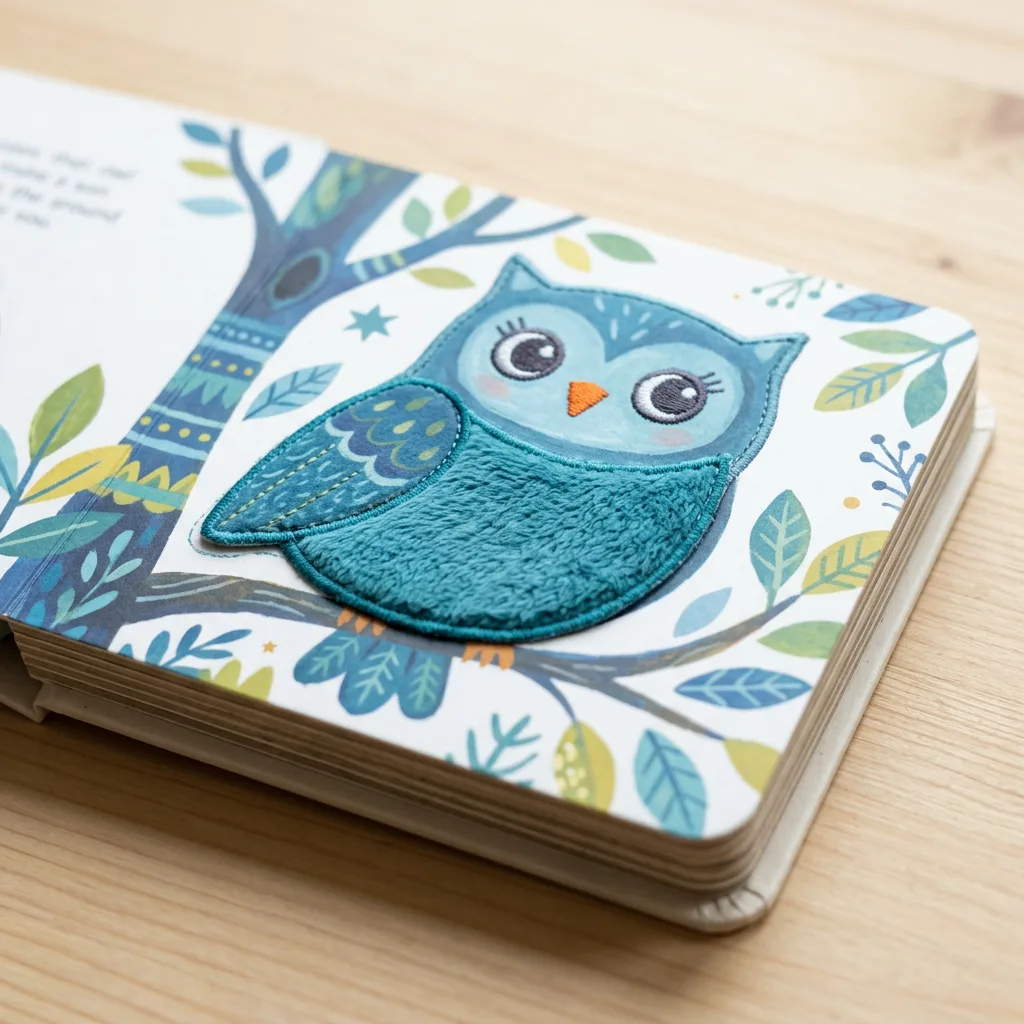
Touch-and-feel elements work best when the texture has an obvious relationship to the image and language on the page. A soft patch may suit an animal illustration, while a contrasting textured area can support descriptive vocabulary or sensory activities. The feature should be large enough for a child to find and explore, without covering essential illustration details.
Material selection affects appearance, feel, application method and the finished page profile. The intended texture, colour, shape and placement should be specified for each page. If several textures are used, identify them consistently in the artwork package and on a component schedule. This helps prevent confusion between visually similar materials during sampling and assembly.
Keep tactile areas away from folds, flap hinges and very narrow board sections unless the construction has been reviewed for that placement. An applied element changes the local thickness of the page, so it can affect how pages close and how a stack of books packs. Simple shapes with clean, intentional borders are generally easier to inspect than highly complex patches.
Where a project also includes buttons or audio, treat electronics as a separate product-engineering decision rather than a minor print finish. Our guide to custom children’s sound book printing explains the additional planning required for audio components, modules and assembly.
Buyer Checklist for Production
Before requesting a quotation or moving to sampling, prepare a concise specification that covers both the printed book and every interactive component.
- Reader and purpose: intended age range, educational objective, retail use or promotional use.
- Book format: finished trim size, orientation, total page count and cover or page construction.
- Interactive plan: number of flaps, die-cut pages, tactile patches or other mechanisms, with a page-by-page description.
- Artwork status: final print-ready files, draft layouts or concept artwork; include separate dielines and technical layers where available.
- Materials and finish: preferred board, paper, lamination or other surface finish, plus the desired tactile material where applicable.
- Quantity and packaging: order quantity, whether individual packing is needed and any carton or retail-pack requirements.
- Proofing: expectations for colour proofing, construction review or physical sample approval.
- Logistics: destination country and delivery address or port information for shipping planning.
Interactive books need extra time for artwork review, component sourcing where applicable, die-making, hand assembly and sample evaluation. The exact workflow depends on the format and feature count. Confirm assumptions at the start rather than relying on a visual mock-up alone.
What Affects Cost, Quality and Lead Time?
The price and schedule for interactive board book printing cannot be estimated from page count alone. A standard board book and a book with multiple flaps or applied materials can have very different production requirements.
Quantity affects how fixed preparation costs, including custom dies and setup work, are distributed across the order. Size and page count influence board consumption, printing area, binding or mounting work, packing volume and freight weight. Feature complexity is also important: the number of die-cut shapes, flap styles, tactile materials and manual assembly operations usually has a direct effect on cost and production time.
Artwork readiness affects the review cycle. Final files with organised technical layers are easier to check than concepts that still require pagination, dielines or interaction details. Sampling requirements, finishing choices, packaging and the destination country can further affect the project timeline and landed cost.
Print quality depends on suitable artwork resolution, colour expectations, material choices, cut accuracy, clean assembly and approval of the relevant proof or sample. For this reason, do not finalise a launch plan until the specific format, components and approval process have been discussed.
Conclusion
Interactive board book printing is most effective when each flap, window or tactile patch has a clear role in the reading experience and is engineered into the format from the beginning. Keep the interaction intuitive, protect the structure around cuts and hinges, and document every component in the production files.
Guangzhou YBJ Printing Co., Ltd has produced custom printed books, paper products and packaging for global customers since 1998. For an accurate discussion of an interactive board book project, provide the product type, trim size, page count, quantity, paper or binding preference, finish, file status and destination country. Include a page plan showing each flap, die-cut or touch feature where possible.