
Table of Contents
- What Are the Main Types of Interactive Board Books?
- Lift-the-Flap Board Books
- Pull-Tab and Slider Board Books
- Touch-and-Feel Board Books
- Die-Cut, Shaped and Wheel Books
- Sound and Combination Board Books
- Interactive Board Book Feature Comparison
- How to Choose the Right Interactive Feature
- Production and Quotation Considerations
- Related Board Book Formats
- Conclusion
The main types of interactive board books include lift-the-flap, pull-tab, touch-and-feel, die-cut, sound and combination formats. Each feature creates a different reading experience and affects artwork, board construction, assembly, quality control and quotation requirements. This guide compares the options so publishers, educational brands and toy companies can choose an interaction that fits their audience and product plan.
What Are the Main Types of Interactive Board Books?
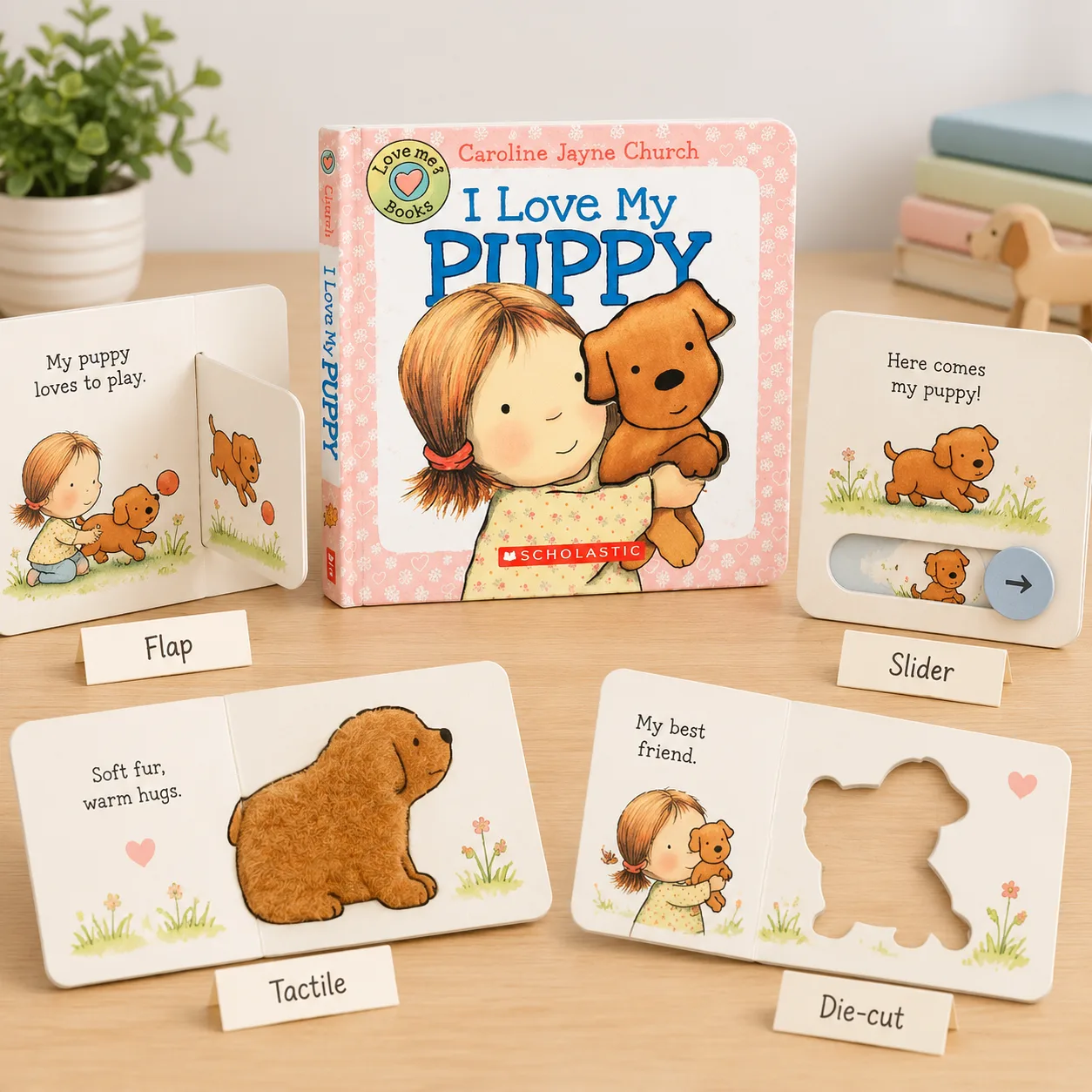
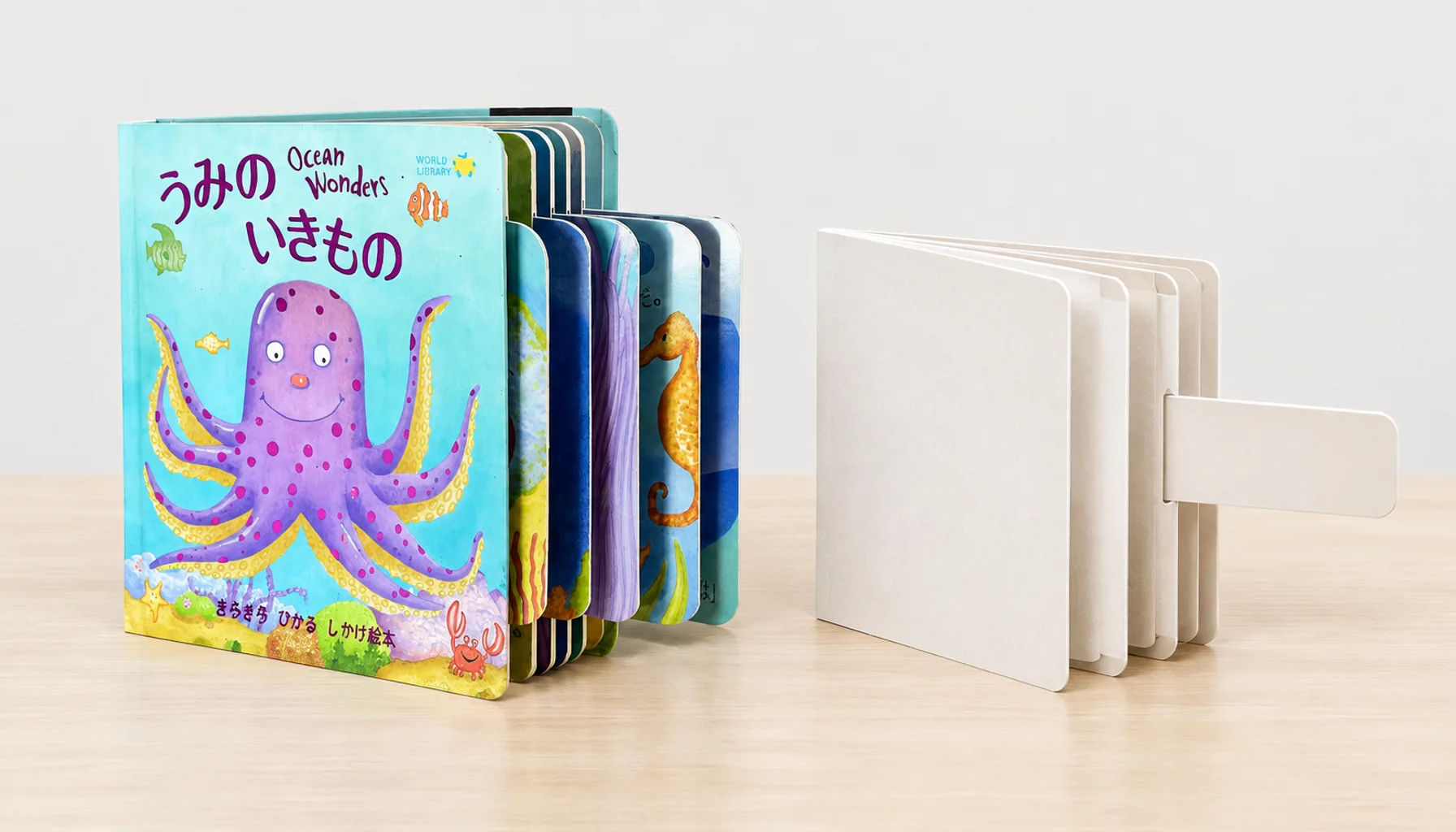
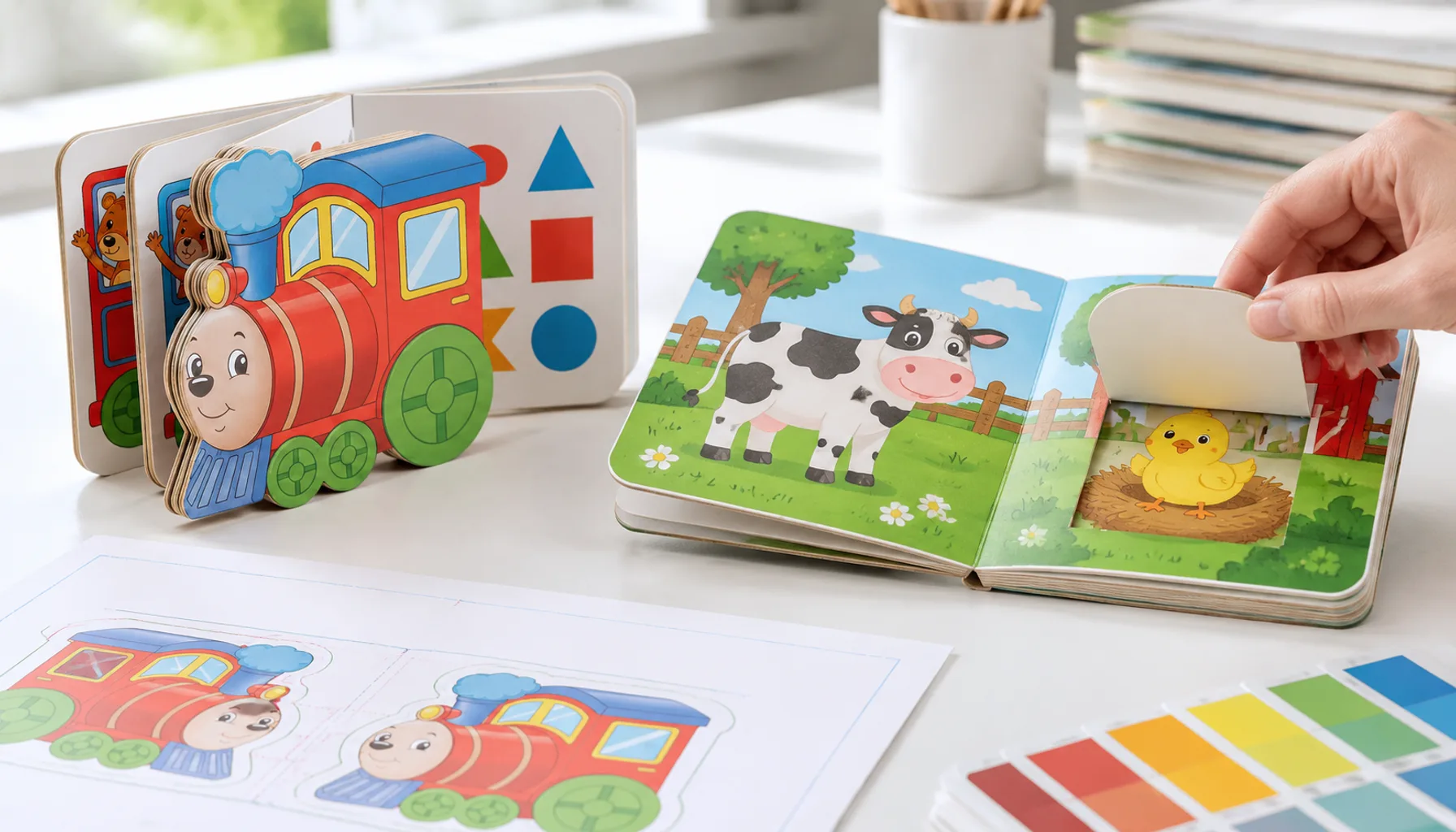
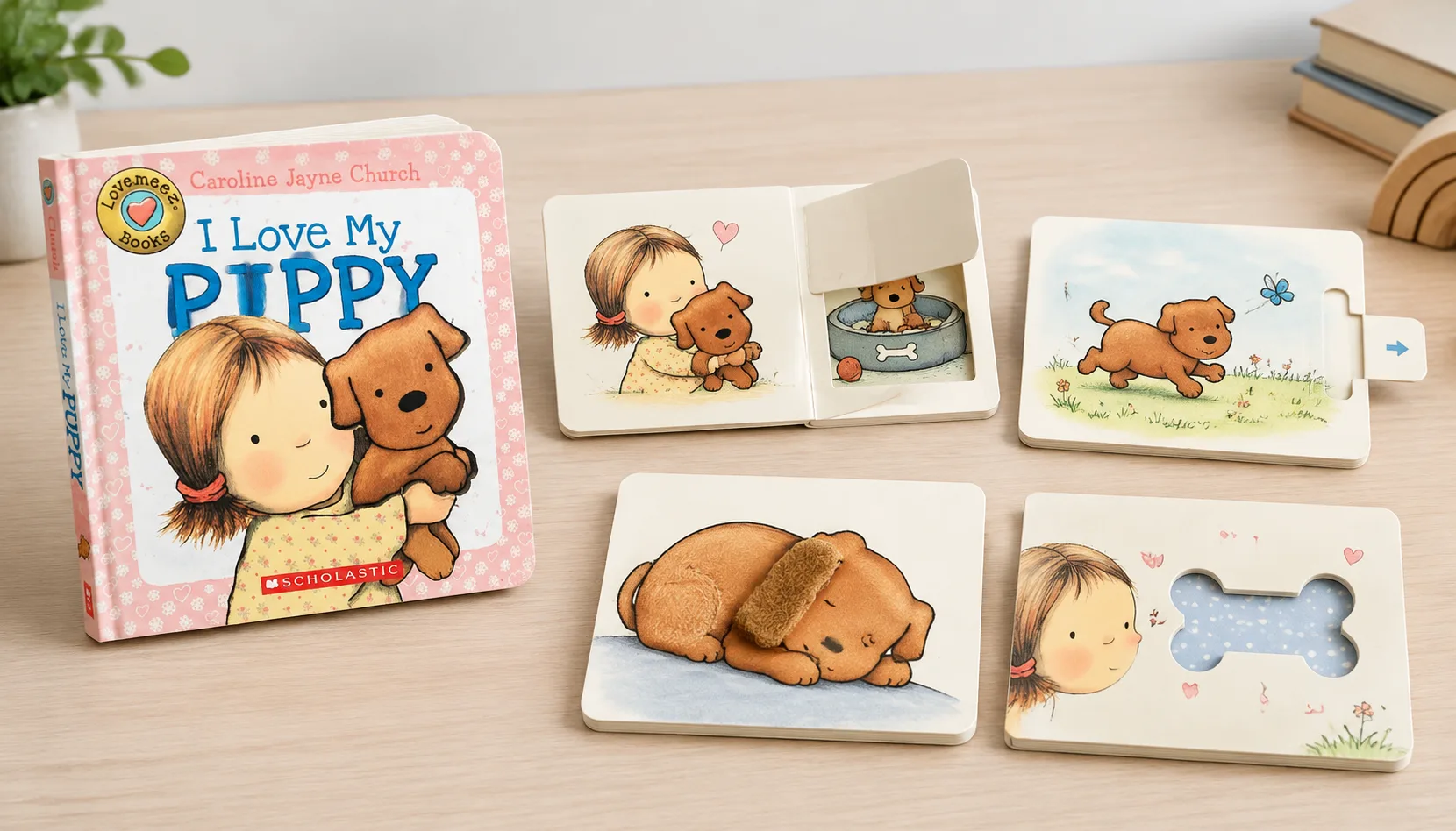
The main types of interactive board books are lift-the-flap, pull-tab or slider, touch-and-feel, die-cut or shaped, sound, and combination books. The right format depends on the intended age group, the type of action the child should perform, the required durability, and the production budget.
For a simple reveal, a lift-the-flap book is usually the most direct option. Pull tabs create movement, touch-and-feel features add a sensory element, and die-cut pages create visual or physical variation. Sound books add electronic components and assembly requirements. Combining several features can increase engagement, but it also increases design, testing and quotation complexity.
In interactive board book printing, the printed page is only one part of the product. The paperboard, fold construction, glued or attached components, coatings, moving parts and final inspection all affect the result. Buyers should decide the interaction before finalising the artwork and page template.
Lift-the-Flap Board Books
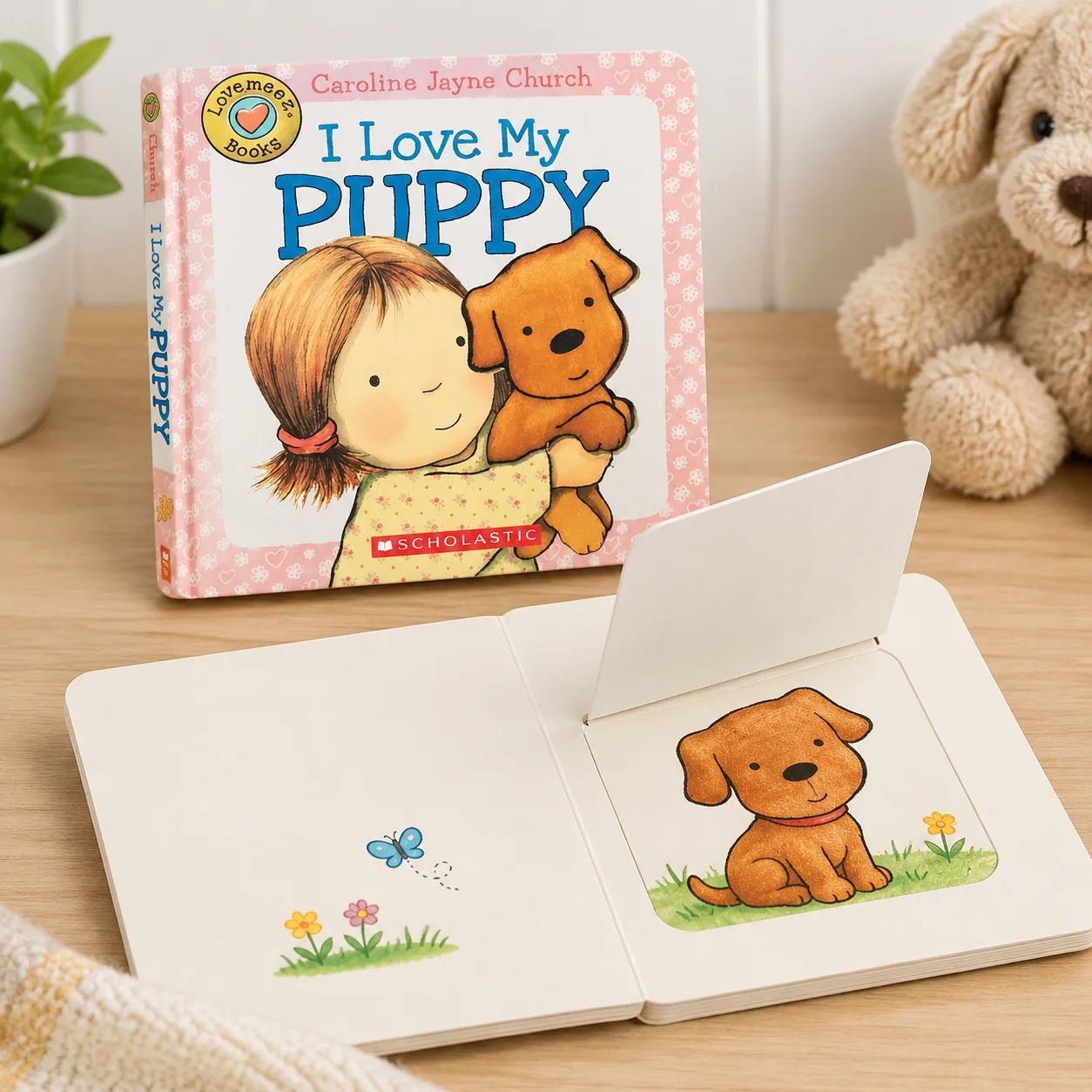
Lift-the-flap books use hinged paperboard panels that conceal an illustration, word, answer or secondary scene. The action is easy to understand, which makes this format suitable for early learning, vocabulary, counting, search-and-find and simple story content.
The main advantages are clear user interaction and relatively straightforward artwork planning. Each flap needs a hinge area, a defined opening direction and enough clearance from nearby artwork. Important text should not sit beneath a flap unless the hidden content is intentional. The flap should also be large enough for the intended user to grasp without creating an unnecessarily weak edge.
When comparing a lift-the-flap vs pull-tab book, consider the type of movement required. A flap reveals content through a short manual lift, while a pull tab moves or changes an illustration. Flaps can be easier for a very young audience to understand, but repeated opening places stress on the hinge and attachment area. A physical sample or production proof is useful before mass production.
Pull-Tab and Slider Board Books
Pull-tab and slider books use a moving paperboard or paper component to reveal, extend, rotate or reposition an image. They can show a vehicle moving, an animal appearing, a character changing clothes or a counting sequence developing across the page.
These books require more mechanical planning than a simple flap. The artwork must account for the visible and hidden positions of the moving part, the direction of travel, the stop points and the clearance needed for the tab. The component should move smoothly without catching on the page or separating during normal handling.
Pull tabs are a good choice when movement is central to the learning or story concept. They may require more assembly and inspection than flaps, particularly when several mechanisms appear in one book. Buyers should provide clear interaction drawings or reference videos where possible, and should confirm whether the mechanism is intended for one-way movement, repeated use or limited positioning.
Touch-and-Feel Board Books
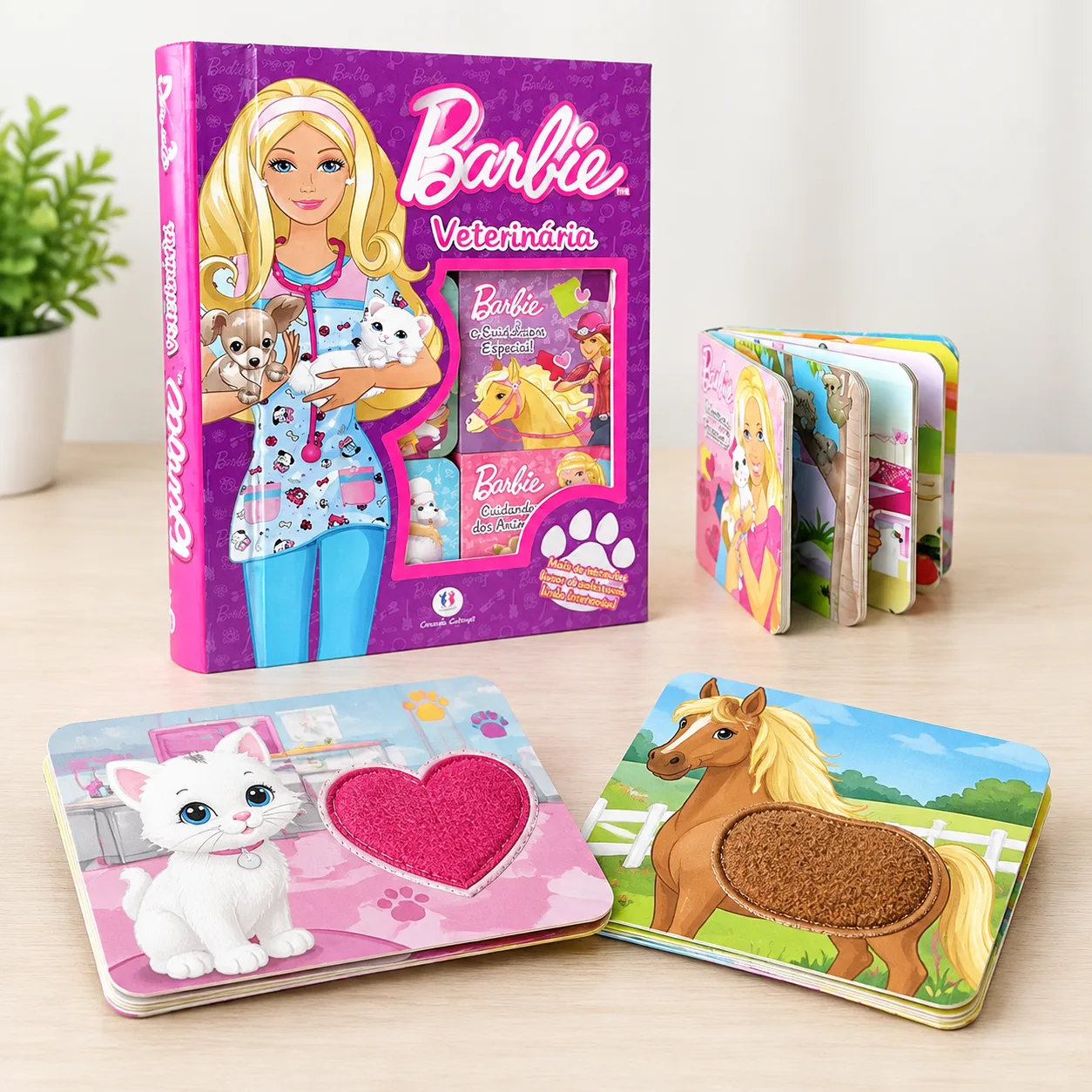
Touch-and-feel board books add a contrasting material or surface that children can explore with their fingers. Common concepts include fur, scales, fabric, soft flocking, raised areas or other tactile inserts. These features are often used in animal, nature, first-word and sensory-learning books.
The key production issue is integration. The tactile material must be positioned accurately, securely attached and compatible with the surrounding printed board. Its texture should support the concept without making the page difficult to clean, turn or stack. The design also needs to show the reader where the tactile element belongs and how it relates to the illustration.
Touch-and-feel board book printing should be discussed early because the material, attachment method, page construction and inspection process may affect the finished size and cost. Our guide to manufacturing touch-and-feel books provides additional questions for planning fabrics and textures.
Die-Cut, Shaped and Wheel Books
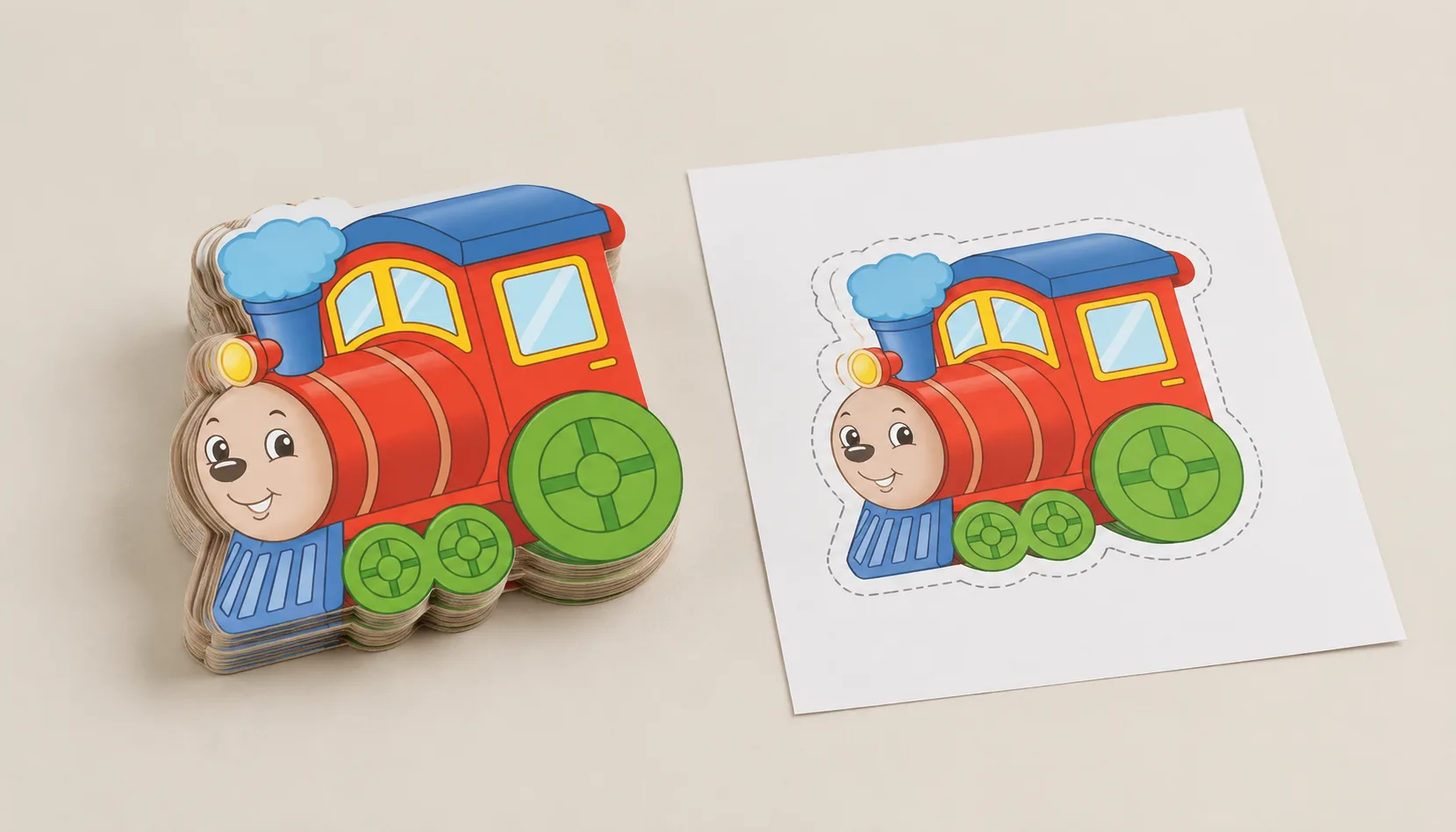
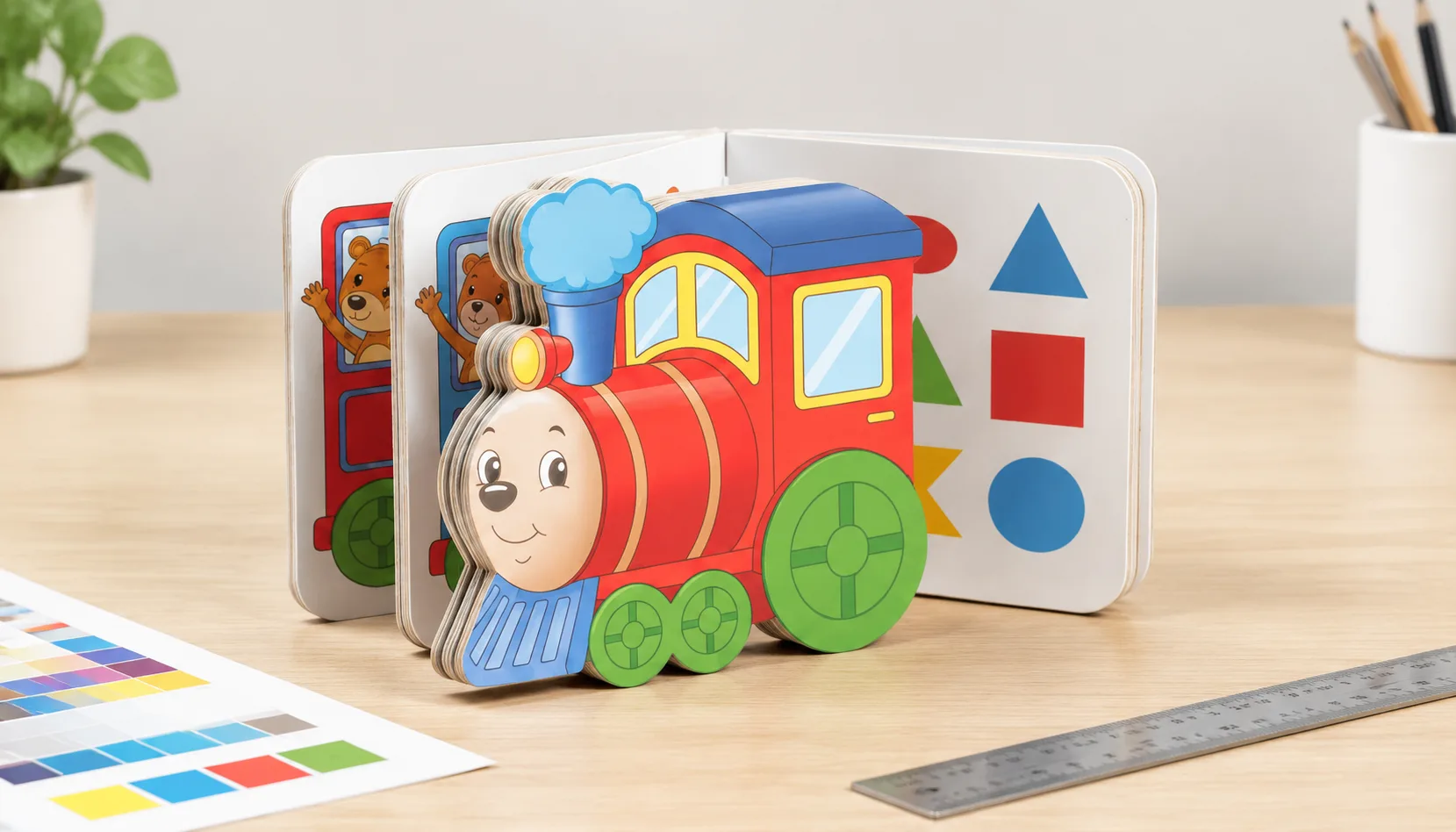
Die-cut and shaped board books use specially cut page edges, windows, holes or silhouettes to change the visual form of the book. A round page, animal-shaped outline, peek-through window or rotating wheel can make the format closely match the subject matter.
Die-cutting is useful when the physical shape is part of the product concept, but it reduces the amount of usable page area and introduces additional artwork constraints. Text and important details need sufficient clearance from the cut line. Internal openings should be checked for alignment from one page to the next, especially when the book uses layered scenes.
Some shaped books also include wheels or simple rotating elements. These should be treated as mechanical components rather than decoration. The buyer and printer need to agree on the rotation point, movement range, attachment method and expected handling before the artwork is finalised.
Sound and Combination Board Books
Sound books add buttons, conductive contacts, a sound module, speaker and battery-powered components to a printed board book. They can support songs, spoken words, animal sounds or simple audio prompts. Combination books may use sound together with flaps, die-cuts or tactile areas.
Sound formats have a different production profile from purely paper-based interactive books. The design must reserve space for the electronic components, define button locations, route activation points and protect the module within the board construction. Assembly, battery access, audio file management and functional testing also become part of the project.
Because component selection and assembly affect the quotation, buyers should describe the number of sounds, approximate audio duration, button layout, battery requirements and packaging expectations. For planning terminology, see this guide to sound book components.
Interactive Board Book Feature Comparison
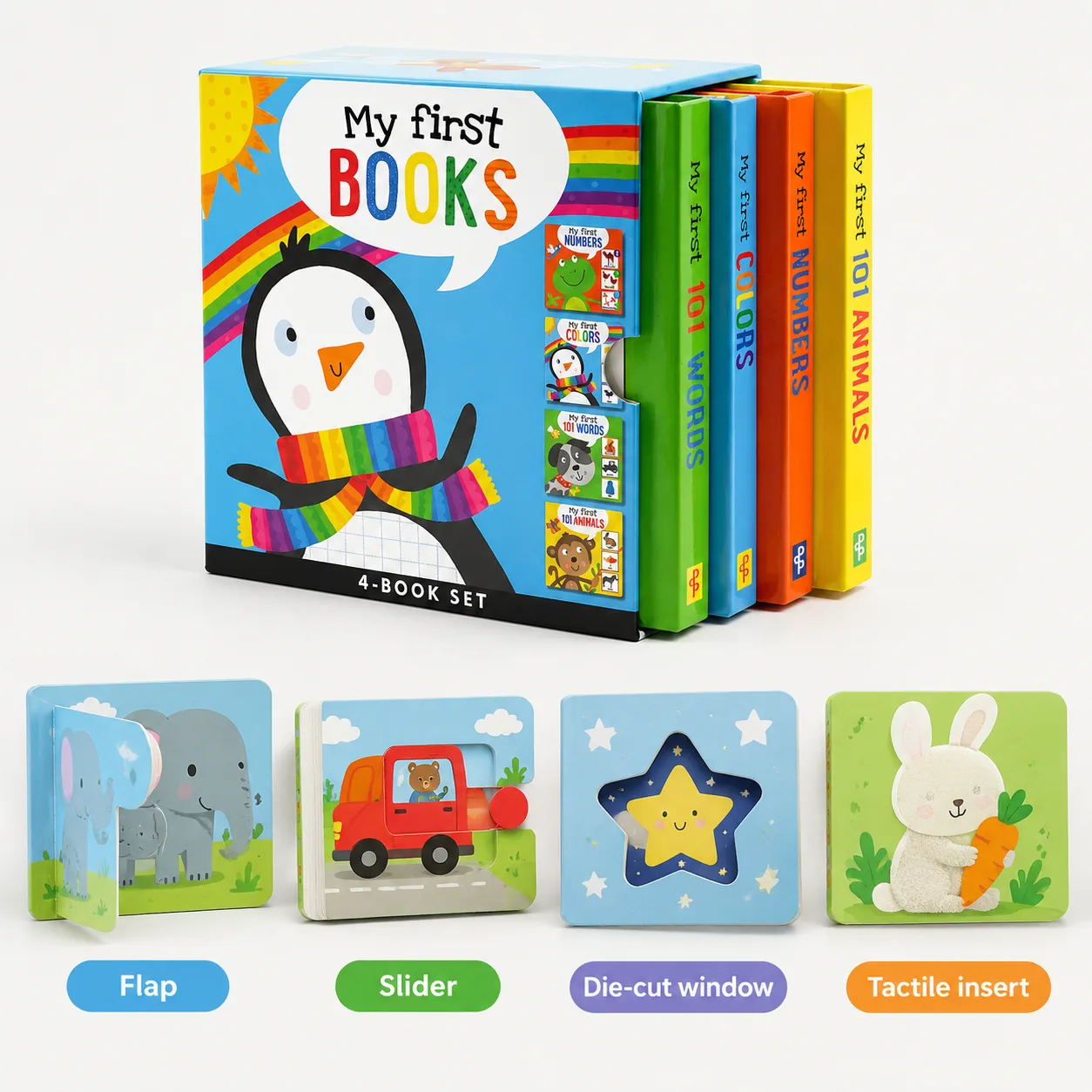
The table below compares the main children’s board book features from a buyer’s point of view. Actual feasibility, cost and production timing depend on the page count, trim size, order quantity, materials, mechanism design and destination country.
| Book type | Main interaction | Suitable applications | Key advantages | Main considerations |
|---|---|---|---|---|
| Lift-the-flap | Open a hinged panel | Early learning, search-and-find, questions and answers | Easy to understand and visually direct | Hinge strength, flap clearance and repeated handling |
| Pull-tab or slider | Move an illustration or panel | Stories, counting, transformation and cause-and-effect | Creates visible motion and active participation | Mechanism design, smooth travel and added assembly |
| Touch-and-feel | Explore a contrasting texture | Animals, nature, first words and sensory learning | Adds a physical sensory layer | Material selection, attachment, cleaning and inspection |
| Die-cut or shaped | Use a special outline, window or wheel | Theme-led formats and visual discovery | Strong connection between shape and subject | Reduced page area, cut-line control and alignment |
| Sound | Press a button to activate audio | Music, pronunciation, stories and sound recognition | Adds audio content and repeatable prompts | Electronic components, assembly, batteries and testing |
| Combination | Uses two or more features | Premium activity books and multi-sensory learning | Broader range of interactions | Highest coordination and specification complexity |
How to Choose the Right Interactive Feature
Start with the learning or reading action, then select the simplest feature that delivers it. A buyer checklist should include:
- Audience: Define the expected age range and whether the product will be used independently or with an adult.
- Interaction: Decide whether the reader should reveal, move, touch, rotate, press or combine actions.
- Durability: Identify which parts will receive repeated handling and where hinges, tabs or attachments need reinforcement.
- Page design: Reserve safe areas for folds, holes, mechanisms, buttons and tactile materials before completing the artwork.
- Product size: Confirm the trim size, closed thickness, open spread and packaging dimensions.
- Budget: Allow for board, special materials, die-cutting, hand assembly, electronic parts, proofing and packing.
- Testing: Plan a physical sample or proof to assess movement, alignment, attachment and overall handling.
For paper and board decisions, review this guide to book printing paper types. The best paper or board choice depends on the interaction and construction, not only on the printed colour result.
Production and Quotation Considerations
An accurate quote for a custom activity board book requires more than a page count. The printer needs to understand the construction and the intended interaction. At minimum, prepare the following information:
- Product type and intended age range
- Trim size, orientation and estimated closed thickness
- Number of pages, spreads or interactive panels
- Quantity and preferred production schedule
- Board, paper, binding and coating preferences
- Feature details, such as flap count, tab direction, tactile material or sound component
- File status, including finished artwork, dielines, audio files and technical drawings
- Packaging requirements and destination country
These assumptions affect both price and lead time. More components normally require more design review, sampling, assembly and inspection. A complete print-ready file can reduce clarification time, but complex mechanisms may still need a physical sample. Use the print-ready book file checklist to review trim, bleed, safe areas, colour and proofing information before submission.
Related Board Book Formats
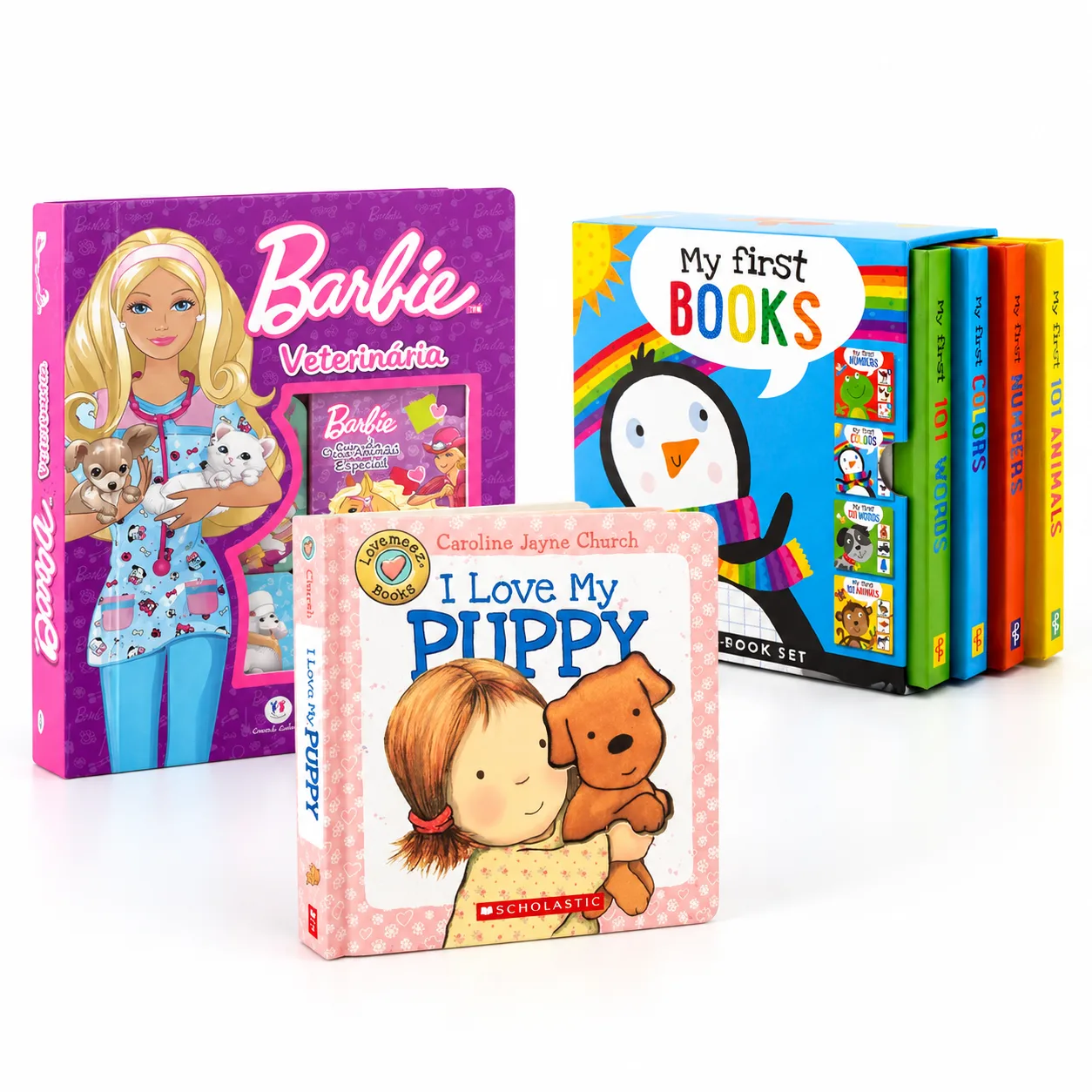
YBJ Printing supplies several board book formats that can be considered when planning an interactive title. The suitable option depends on whether the project is a single story book, a boxed set or a multi-title learning product.
| Format | May suit | Buyer discussion point |
|---|---|---|
| Board book and hardcover printing | Individual board book projects and durable hardcover-style formats | Confirm the interaction, board construction, cover treatment and finished dimensions. |
| Children’s story board book set printing | Multi-title story collections and coordinated children’s series | Plan title consistency, set packaging, quantities and any shared interactive components. |
| Custom board book set printing | First-concept, vocabulary, colour, number and themed learning sets | Confirm the number of books, slipcase or packaging requirements and artwork structure. |
These are starting points for discussion rather than fixed specifications. A quotation should be based on the final artwork, construction, quantity and destination.
Conclusion
The best interactive board book format is the one that delivers the intended action with an appropriate level of construction complexity. Choose flaps for simple reveals, pull tabs for movement, tactile materials for sensory discovery, die-cuts for shape-led concepts, and sound for audio learning. Combination formats can be effective when each feature has a clear purpose.
Before approving production, confirm the interaction, artwork setup, materials, sample requirements, quantity, packaging and destination. These details give the printer a clearer basis for reviewing feasibility and preparing a quotation.
FAQ
What are the main types of interactive board books?
The main types are lift-the-flap, pull-tab or slider, touch-and-feel, die-cut or shaped, sound and combination board books. Each type creates a different reader action and has different construction requirements.
Which is better, a lift-the-flap or pull-tab book?
A lift-the-flap book is usually better for revealing hidden content. A pull-tab book is better when the concept depends on visible movement or transformation. The choice depends on the learning objective, age group and mechanism requirements.
Does an interactive board book cost more than a standard board book?
It can cost more because interactive features may require extra board components, die-cutting, special materials, hand assembly, electronic parts, sampling and inspection. The final price depends on the design, quantity and destination.
What information is needed for an interactive board book quotation?
Provide the product type, trim size, page count, quantity, paper or board preference, binding, finish, interactive feature, file status, packaging requirements and destination country. Mechanism drawings, reference samples or audio details may also be needed.
Should I request a physical sample before mass production?
A physical sample is useful for checking flap movement, pull-tab travel, tactile attachment, die-cut alignment, sound activation and overall handling. The need depends on the complexity and risk of the proposed construction.
Discuss Your Interactive Board Book Project
To request a practical quotation from YBJ Printing, share your product type, trim size, page count, quantity, paper or binding preference, finish, file status and destination country. Add drawings or samples for any flaps, tabs, tactile areas, die-cuts or sound components so the construction can be reviewed accurately.